
A suction grab bar isn’t designed to support your full body weight. Its weight limit does not tell you how much force you can safely put on the bar.
It makes sense to look for a clear weight rating before relying on a bathroom support. But the number alone doesn’t tell you whether the bar is secure. Suction, surface condition, moisture, temperature, and tile texture can all affect its grip.
This guide explains what weight limits mean, why suction can fail, and how to check that a bar is securely attached before use. You’ll also learn which surfaces can support a seal and what to do if a bar feels loose or shows signs of wear, so you can make a more informed choice for everyday balance support.
Key Takeaways
- Check the bar’s attachment before each use, and remove and reattach it if it feels loose.
- Keep suction cups clean and dry, with no oil or dust interfering with the seal.
- Surface matters: suction bars need a clean, flat, non-porous area, not textured tile, drywall, or painted surfaces.
- Moisture, sunlight, and freezing temperatures can affect suction and cup condition over time.
- Use suction-mounted bars for balance support, not to hold your full body weight.
Checking suction security
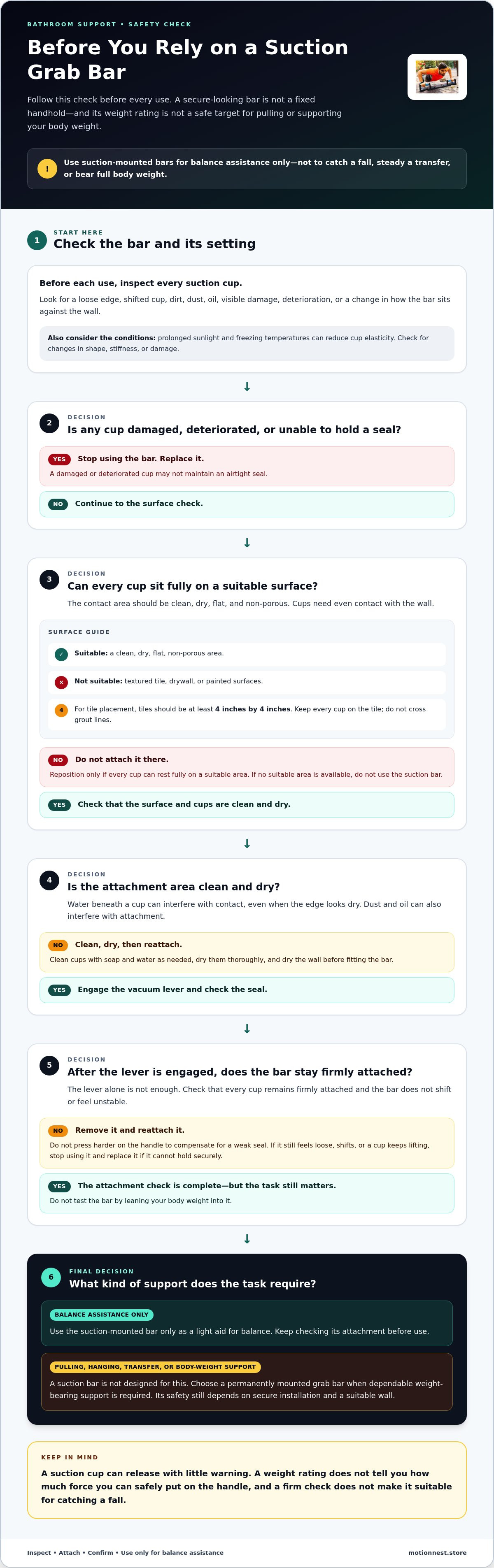
Check a suction-mounted grab bar before every use. Its grip can weaken over time, even if it felt firm the last time you used it. Look for a loose edge, a shifted cup, or a change in how the bar sits against the wall. Never rely on a bar that moves or feels unstable.
Start by inspecting each suction cup and its contact with the surface. Look for visible damage, deterioration, dirt, oil, or a lifted edge. Dust and oil can interfere with attachment, while a damaged cup may not hold an airtight seal. If a cup is damaged or deteriorated, replace the bar rather than using it.
Check the attachment before use
Engage the vacuum lever, then confirm that the bar sits securely against the wall. The lever alone isn’t enough: the cups must remain firmly attached after it’s engaged. Don’t test the bar by leaning your body weight into it. A suction-mounted bar is for balance assistance, not for supporting full body weight.
If the bar feels loose, remove it and reattach it before use. Don’t try to compensate for a weak seal by pressing harder on the handle. Clean the suction cups with soap and water as needed, then dry them thoroughly. Make sure the attachment area is clean and dry before reattaching the bar.
- Look over every cup for damage, deterioration, dust, or oil.
- Engage the vacuum lever and check that the bar stays securely attached.
- Remove and reattach the bar if it becomes loose.
- Replace the bar if it cannot keep a secure, airtight seal.
Tile layout matters during placement. Wall tiles should be at least 4 inches by 4 inches so the suction cups can sit on tile without crossing grout lines. A cup placed partly over grout may not form an even seal. Check the position of every cup, not just the handle’s overall alignment.
After cleaning or repositioning the bar, inspect the seal again before use. If a cup keeps lifting, the bar shifts, or the seal won’t hold, stop using it and replace it. Regular checks can catch changes between uses, but they don’t make a suction bar suitable for pulling or bearing full body weight.
Effects of moisture, temperature, and surface texture
A suction cup needs close contact with a suitable wall to form a seal. Water, uneven texture, and changes in the cup’s flexibility can interfere with that contact. That’s why a bar that holds on one bathroom surface may not attach securely to another. Check the wall and the cup’s condition together, rather than focusing only on the handle’s position.
Moisture matters where the cup meets the wall. A wet surface can prevent a firm attachment, and dampness may remain beneath a cup after a shower. Attach a suction grab bar only to a clean, dry, flat, non-porous surface. If water is present, dry the wall and cup fully before fitting the bar. A dry-looking edge doesn’t prove the contact area underneath is dry.
Surface texture matters as much as moisture. Textured tile, drywall, and painted surfaces aren’t suitable for suction cups. Small ridges, pores, and uneven areas can break contact along the cup’s sealing edge. A tile may look smooth from a distance but have a raised pattern that prevents an even seal. Choose a flat, non-porous area where the entire cup can rest against the surface.
How temperature and sunlight affect suction cups
Prolonged sunlight and freezing temperatures can cause suction cups to lose elasticity. A less flexible cup may not conform closely to the wall, making it harder to maintain an airtight seal. A bathroom near a sunny window may expose the bar to extended sunlight, while a cup stored in freezing conditions may also lose flexibility. These conditions affect the cup itself, not just the wall beneath it.
Before using a bar exposed to strong sunlight or freezing temperatures, inspect the cups for changes in shape, stiffness, or damage. Don’t use a cup that looks deteriorated or fails to hold securely. If it can’t maintain an airtight seal, replace the bar. A temperature-related change may persist even after moving the bar to a more suitable location.
- Use a clean, dry, flat, non-porous surface.
- Avoid textured tile, drywall, and painted walls.
- Keep cups away from prolonged sunlight and freezing temperatures.
- Replace cups that show deterioration or cannot hold a seal.
These checks help you judge whether the wall and surrounding conditions suit suction attachment. If you’re also exploring practical home supports, browse practical home products for an option that fits your routine.
Risk of sudden suction loss
A permanently mounted grab bar doesn’t rely on a suction seal, so it isn’t subject to sudden suction loss. Its safety still depends on secure installation and a suitable wall. Use suction-mounted bars only as balance assistance.
A suction cup can release with little warning if its seal weakens. Unlike a fixed handhold, the bar may shift or detach when someone reaches for it. Pulling hard or leaning full body weight on it can also affect balance if it suddenly moves. Treat the bar as a light aid, not as something to catch a fall.
That range isn’t a safe target for pulling, hanging, or supporting full body weight. Movement can put force on a handle differently from a steady test load. Even a bar that appears attached may lose suction, so its stated capacity can’t eliminate the risk of an unexpected release.
Consider this example: someone steps into a shower and reaches sideways for a suction bar while shifting their weight. If one cup releases, the handle may tilt or move, leaving less support when it’s needed. The risk is especially relevant when the bar is used instead of a fixed support. Don’t use a suction bar to steady a transfer or recover from a slip.
- Use a suction-mounted bar only for balance assistance.
- Don’t pull, hang, or place full body weight on the handle.
- Stop using it if it moves, feels loose, or loses its seal.
- Choose a fixed grab bar when the task requires dependable weight-bearing support.
Daily routines can involve repeated reaches, turns, and changes in balance. Match the support to the task rather than relying on a weight rating alone. A suction bar may offer a convenient handhold for light balance support, but it shouldn’t replace a properly secured grab bar when someone needs to bear weight.
The key concern is sudden release: suction can fail even after the bar seemed secure. Keep its role limited, and don’t use it as an emergency handhold. For support that must carry body weight, use a permanently mounted grab bar properly installed for that purpose.
Suction cup grab bar weight limits
A weight rating isn’t permission to use a suction bar as full-body support. The surface, seal, and intended use all matter.
Weight Limit Testing and Certification
A stated weight limit is a product rating. Independent certification means an outside body has assessed a product against a defined standard. The distinction matters because a number on a package alone doesn’t explain how the bar was tested or under what conditions. The practical point: a rating doesn’t make a suction-mounted bar suitable for pulling, hanging, or catching a fall.
That range shouldn’t be treated as a safe working load for everyday movement. A test load can differ from the force created when someone grips a handle while turning, stepping, or losing balance. Suction can also weaken, changing how well the bar holds against the wall.
Read a product’s stated use alongside its rating. The suction grab bar weight limit alone can’t tell you whether a particular wall provides a secure seal. Use this type of bar only as a balance aid, and don’t rely on it to support your full body weight. A numeric rating doesn’t eliminate the risk of sudden suction loss.
Installation and Weight Capacity Guidelines
For safe use, attach suction cup grab bars only to clean, dry, flat, non-porous surfaces and use them only for balance assistance. They aren’t intended to support a person’s full body weight. An unsuitable surface can weaken the attachment, regardless of the number printed on the bar.
For installation, wall tiles should be at least 4 inches by 4 inches, allowing the cups to sit on tile without crossing grout lines. Avoid textured tile, drywall, and painted surfaces. A cup that overlaps a grout line or rests on an uneven texture may not form a proper seal. Check the placement of every cup against the wall before relying on the handle.
The practical guidance for readers in the U.S. is straightforward: treat a suction-mounted bar as a balance aid, not a weight-bearing grab bar. If a task involves lifting, pulling, or supporting full body weight, a suction model isn’t the right support. A load rating can’t compensate for an unsuitable surface or a seal that releases.
Consider the movement the bar needs to support, not just its rating. Reaching for balance differs from leaning heavily during a transfer. Matching the support to the task helps prevent mistaking a number on a label for a guarantee of stability.
Are suction grab bar weight limits tested or independently certified?
A weight limit is a stated capacity, while independent certification means an outside organization has assessed a product against a defined standard. The label alone doesn’t tell you what process supports the number. That distinction matters because a rating may describe a particular test condition, not every movement a person makes in a bathroom.
For example, a test applying steady force differs from the quick, uneven pull of someone losing balance. A person may grip the handle while turning or stepping, creating force in a different direction. The printed capacity doesn’t explain how the bar responds to those movements, how long it held, or what surface was used for testing.
Look for the exact wording around a product’s weight claim. A stated capacity, a manufacturer’s test claim, and independent certification are different kinds of information. Certification should identify the assessing organization and the standard involved. A general phrase such as “tested for strength” doesn’t explain who performed the test or the conditions applied.
That distinction doesn’t change the basic limit of suction-mounted bars. A rating can’t make a suction cup suitable for supporting someone’s full body weight or catching a fall. Suction can weaken, so a test result isn’t proof that the bar will stay attached in every setting.
Use a few practical checks when reading a product label or instructions:
- Find the stated weight capacity and note whether it describes a specific test condition.
- Look for the name of an independent certifying organization and the standard it assessed.
- Read the stated purpose, especially whether the bar is limited to balance assistance.
- Compare the intended wall surface with the surface where the bar will be used.
These details help distinguish a number from the conditions behind it. A capacity figure, for instance, doesn’t tell you whether a bar was tested on tile, whether the cups were newly attached, or whether the load was steady. Those differences matter because a suction seal depends on contact between the cups and the wall.
Treat the rating as one piece of product information, not permission to lean heavily or transfer body weight onto the handle. A suction-mounted bar’s practical role remains balance assistance. Review the instructions and use limits before choosing a bar, then match it to a suitable surface and the task it is meant to support.
Motion Nest: Bathroom Handrail With Vacuum Sucker For Safety Support
Motion Nest offers the Bathroom Handrail With Vacuum Sucker For Safety Support for readers considering a suction-mounted bathroom handhold. It may suit a routine that calls for balance assistance, not support for full body weight or fall protection. The wall surface and secure attachment still matter, so use it only where conditions are suitable for suction cups.
Before choosing this type of support, consider the task it needs to help with. If you need a fixed, weight-bearing handhold, a suction-mounted bar isn’t the right fit. If a suction handhold suits your balance-support needs, explore the product at motionnest.store.
Choose support that fits your routine
Before adding a handhold to your bathroom, think about when you want support: reaching for a towel, changing direction, or moving beside the sink. This can help you decide whether a suction-mounted option fits the task or whether your routine calls for another type of support. The suction grab bar weight limit matters, but so does choosing a support that matches how you’ll use it.
Motion Nest offers the Bathroom Handrail With Vacuum Sucker For Safety Support for people considering a suction-mounted handhold. Make your next step a practical one: explore the product details and decide whether this style suits your intended use. Explore Motion Nest’s bathroom handrail and choose the option that feels right for your routine.
Frequently Asked Questions
What is the typical weight limit of a suction grab bar?
That figure shouldn’t be treated as the amount of body weight you can safely place on the handle. The suction grab bar weight limit describes a rating, not a promise that the bar will stay attached during a slip or sudden pull. Use the bar only as a balance aid, and choose another support for weight-bearing tasks.
How much weight can popular suction grab bar brands support?
There isn’t one weight capacity for every popular brand or model. Ratings vary between individual bars, so use the stated limit for the exact model rather than assuming a brand-wide figure. A brand name alone doesn’t tell you how the bar is intended to be used.
Do suction grab bars support full body weight or only balance assistance?
Suction grab bars are intended for balance assistance, not for supporting a person’s full body weight. For example, they shouldn’t be treated as a handhold for pulling yourself up or catching yourself during a fall. Those actions can apply sudden force to the bar. Match the support to the movement: a suction bar offers a balance aid, while weight-bearing support calls for a different solution.
What affects a suction grab bar’s holding strength and weight capacity?
The condition of the suction cups, the wall surface, and the seal all affect how securely a bar attaches. A dusty cup edge or textured surface, for example, may prevent even contact. Moisture can also interfere with attachment, while prolonged sunlight or freezing temperatures can reduce cup elasticity. A printed capacity can’t account for every change in the bar’s condition or installation surface.
Which surfaces are safe for installing a suction grab bar?
Use a clean, dry, flat, non-porous surface, such as smooth tile where each cup can sit evenly. Textured tile, drywall, and painted surfaces aren’t suitable. Inspect the area where every cup will land: a wall that appears smooth from across the bathroom may have ridges or grout that interrupt contact. Each cup needs an even seal across its surface, not just the handle’s central area.
How can you tell whether a suction grab bar is securely attached?
After engaging the vacuum lever, check that the bar sits firmly against the wall and no cup edge is lifting. Look for movement, a shifted position, or looseness before relying on it. Don’t test the attachment by hanging your body weight on the handle. If the bar moves, remove and reattach it. If the seal won’t hold, replace it.
How often should suction grab bars be checked or reattached?
Check a suction grab bar before every use because its grip can weaken over time. If it becomes loose, reattach it rather than using it in a shifted position. Clean the cups with soap and water as needed, then dry them thoroughly before use. If the cups are damaged or deteriorated, or can’t maintain an airtight seal, replace the bar instead of repeatedly repositioning it.
What are the risks of using a suction grab bar for fall prevention?
A suction bar can lose its grip suddenly, so relying on it to catch a fall may leave you without support when you need it. A release can also shift your balance as you reach for the handle. Use suction-mounted bars only for balance assistance, not as fall-arrest devices or supports for full body weight. Consider the movement involved before choosing a handhold for a bathroom routine.