
A suction handle can feel reassuring, but the surface beneath it matters more than the destination. A portable grab bar for travel can provide a temporary handhold for bathing when its cups attach securely to a compatible surface. It won’t fit every shower or tub, so check the surface, placement, and intended use.
It’s understandable to want a support option that’s easy to pack and set up away from home. But a lever that appears closed doesn’t, by itself, confirm that the bar is stable or suitable for the surface. Knowing what to check can help you choose more confidently.
This guide explains how suction cups and levers work, which surfaces can make installation unsuitable, and how to match a portable handhold to your bathing needs. You’ll also learn when a suction-mounted bar may help with balance and when it isn’t suitable for the task.
Key Takeaways
- Match the suction cups to the surface and available space before packing a travel handle.
- Learn what lever closure can tell you about attachment, and what it can’t tell you about stability.
- Consider installation limits and the kind of support you need during bathing before choosing where to place a handle.
- See how a vacuum-suction bathroom handrail may suit your routine, and when portable support may not fit your needs.
Suction attachment and stability
Suction cups hold by creating a vacuum against a compatible surface. Before using a portable grab bar for travel, review its surface requirements, fit, and installation instructions. The same handle may attach securely in one bathroom but not in another.
How Suction-Cup Bars Work
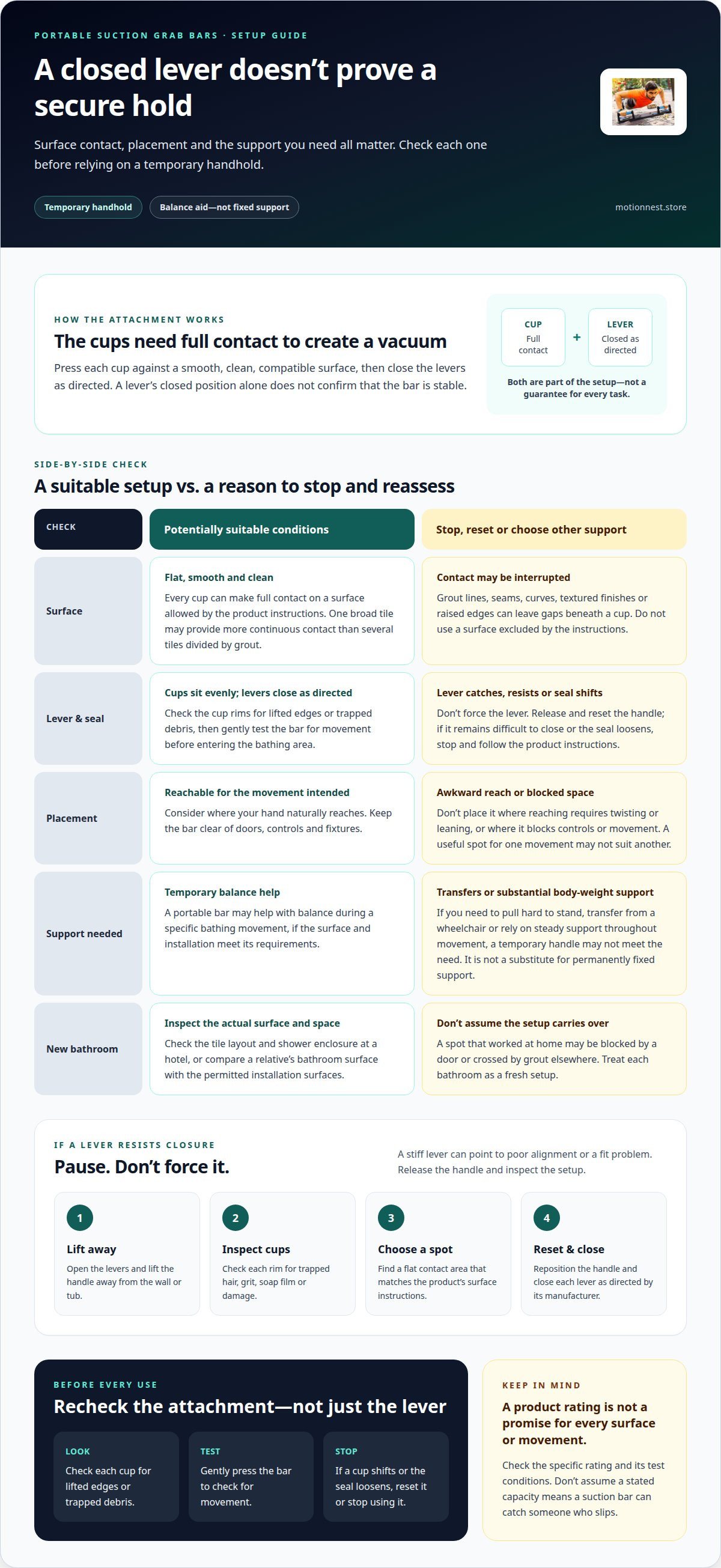
Press each cup against a smooth, clean surface, then close its lever as directed. A secure seal requires full contact between the cup and surface. Grout lines and textured tile can interrupt that contact. Use the bar only on surfaces allowed by its instructions, and treat it as a balance aid, not a replacement for fixed support.
Weight Support and Rating Tests
There isn’t one weight limit for every travel bar. Check the specific product’s stated rating and the test conditions it describes. A rating may depend on how force is applied, the surface, and installation. Don’t assume a stated capacity means a suction bar is suitable for every movement or can catch someone who slips.
Check the Surface Before Attachment
Inspect the intended spot before installing the handle. Choose a flat area where every cup can make full contact. Avoid seams, grout channels, curves, and textured finishes that can leave gaps beneath the rim. For example, one broad tile may offer a more continuous contact area than several small tiles divided by grout. Follow the product’s surface restrictions.
Recheck the Seal Before Use
After closing the levers, check each cup for lifted edges or trapped debris. Gently press the bar to check for movement before entering the bathing area. If a cup shifts, release the bar and reset it on a suitable surface. Check the attachment again after repositioning, and stop if the seal loosens.
When choosing a portable grab bar for travel, prioritize surface compatibility and clear installation instructions over convenience alone.
Difficulty closing the suction levers
If a lever resists closure, don’t force it. The handle may be uneven, a cup may not be fully seated, or the surface may prevent a clean seal. For example, a cup overlapping a grout line may sit differently from one resting flat on a tile. Pause and inspect the setup before trying again.
Use this sequence to troubleshoot:
- Open the levers and lift the handle away from the wall or tub.
- Check each cup’s rim for trapped hair, grit, soap film, or damage.
- Choose a flat contact spot that matches the product’s surface instructions.
- Place the handle again, then close each lever as directed by its manufacturer.
If a lever still won’t close with normal pressure, don’t force it or use the bar. A stiff lever can indicate poor alignment or a fit problem, and forcing it may damage the mechanism. Reposition the handle on a suitable spot. If the lever remains difficult to close, stop and follow the product instructions for troubleshooting.
Pay attention to how both levers feel. If one closes smoothly but the other catches, check whether the handle is level and both cups sit evenly. A twisted position, such as one end pressed against a raised tile edge, can make closure harder. Release and reset the handle rather than pushing harder.
Before bathing, test the installed bar gently for movement, as described in its instructions. A lever’s closed position alone doesn’t prove the attachment is secure. For a suction-mounted bathroom handrail, compare the setup steps with the product’s directions before use. The Bathroom Handrail With Vacuum Sucker For Safety Support is one option to explore for a temporary handhold, provided its installation requirements suit your bathroom surface.
Installation and use restrictions
A travel bathroom may differ from the one where you first tested a suction bar. Check the actual wall or tub surface, available space, and intended hand position before installing it. A suitable spot at home may be blocked by a shower door or crossed by grout in a hotel. Treat each new bathroom as a fresh setup, not an automatic repeat.
Use the product’s installation instructions to guide placement. If they exclude a surface or use, choose another support option rather than improvising. For example, don’t attach a handle across a curved tub edge if its cups require a flat area. A lever that closes doesn’t override a surface restriction.
Position the bar for the movement it will support. A handle near the shower entrance may help with balance while stepping in, but may not suit standing up from a low tub. Before bathing, consider where your hand naturally reaches and whether the handle will stay clear of doors, controls, and other fixtures. Don’t place it where reaching requires twisting or leaning.
- At a hotel: inspect the tile layout and shower enclosure before unpacking the handle.
- At a relative’s home: compare the surface with the product’s permitted installation surfaces.
- Before each use: make sure the handle does not block the shower controls or your movement.
A suction-mounted bar isn’t a substitute for a permanently fixed grab bar when dependable support is needed for transfers or substantial body weight. If bathing involves pulling hard to stand, transferring from a wheelchair, or needing steady support throughout movement, a temporary handle may not meet that need. Choose support for the specific task, not portability alone.
Remove the bar according to its instructions before packing it. In the next bathroom, repeat the surface and placement checks. This simple reset helps prevent assumptions based on different tile, tub shapes, or shower layouts.
Portable support for bathing and showering
Choose a travel handle based on the bathing movement you want help with. Stepping over a tub edge, reaching for a shower control, and standing from a seat call for different hand positions. For example, someone seeking balance while entering may need a reachable handhold near the entrance. A handle placed elsewhere may not help with that movement.
Think through your routine before packing a portable bar. Identify where you pause, turn, or shift your weight, then consider whether a temporary handhold can fit there. Keep the handle clear of the shower door and controls. If you need to pull hard to stand from a low seat, a suction-mounted option may not provide the support that task requires.
Portability is useful when bathrooms change, but each setup depends on the surface and the product instructions. A handle that suited one hotel shower may not suit another bathroom’s layout. Plan to inspect the new space and install the bar according to its directions. Don’t rely on your memory of a previous stay.
- For entering: choose a reachable position that doesn’t obstruct the doorway.
- For showering: keep the handle clear of controls and your natural movement.
- For rising: consider whether the task needs firmer, fixed support.
A portable bar may serve as a convenient handhold for light balance during a familiar routine when the bathroom and installation meet the product’s requirements. It isn’t suitable for every bathing need. For example, someone who needs steady support during a transfer should choose support designed for that task rather than relying on portability alone.
Motion Nest offers the Bathroom Handrail With Vacuum Sucker For Safety Support for shoppers considering suction-mounted bathroom support. Compare its product instructions with your bathing routine and bathroom surface before deciding. Explore bathing support options as you consider a practical fit for your routine.
Motion Nest: Bathroom Handrail With Vacuum Sucker For Safety Support
Motion Nest sells the Bathroom Handrail With Vacuum Sucker For Safety Support, a suction-mounted handhold for shoppers considering temporary bathroom support. It may suit a bathing routine when the surface and product instructions allow attachment. Review the directions and compare them with your intended placement before use. A temporary handrail isn’t a substitute for fixed support when bathing involves transfers or substantial weight-bearing.
Consider this option if you’re looking for a vacuum-suction bathroom handrail for everyday support. The key question is whether its installation requirements suit the surface and the movement you need help with. If you need support beyond a temporary handhold, choose an option designed for that need.
Visit motionnest.store to explore the bathroom handrail.
Make Your Next Bathing Setup Feel More Considered
Before your next trip, decide what kind of support would make bathing more manageable. A portable grab bar for travel is only one part of that plan. Think about the movements you want help with and whether a temporary handhold suits your needs. This can help you choose support for your routine, rather than packing something simply because it’s portable.
Take time to consider your preferences before you leave. If you’re exploring a suction-mounted bathroom handrail, Motion Nest offers the Bathroom Handrail With Vacuum Sucker For Safety Support. Choose based on your bathing routine and the intended setup, not portability alone.
Contact Motion Nest for help exploring its bathroom handrail. Take the next step at your own pace and feel more prepared for your travels.
Frequently Asked Questions
Which portable grab bars are best for showers, bathtubs, and toilets?
The right choice depends on the surface and the movement you need support with. For a shower, match the bar’s suction requirements to a suitable wall area. For a bathtub, consider where your hand needs to reach while entering or standing. Beside a toilet, check that the handle fits without blocking transfers or movement. One style may not suit all three locations.
How do you install and remove a portable grab bar correctly?
Follow the model’s instructions for installation and release, since lever designs can differ. Before attaching the bar, clear the intended spot and position it where it won’t obstruct controls or doors. To remove it, use the product’s release mechanism rather than pulling it away by force. Pack the bar only after it’s detached and dry, so it’s ready for another bathroom.
What are the risks and limitations of portable grab bars?
A portable suction bar can lose its hold if the surface, cup fit, or installation isn’t suitable. It may also be poorly positioned for a particular movement, such as turning from a shower seat. Treat it as a limited handhold, not a universal substitute for fixed support. Someone who needs substantial help with transfers may need another support arrangement.
How can you tell whether a suction grab bar is securely attached?
Look for even contact around each cup and confirm that every lever is fully closed as directed. Then follow the manufacturer’s test method, applying only the recommended pressure. For example, after cleaning the shower and reinstalling the bar, check the attachment again instead of relying on its previous setup. Stop if a cup edge lifts or the handle shifts.
Are portable grab bars allowed in hotels, rentals, or public restrooms?
Permission depends on the property’s rules and the type of space. A hotel or rental may set conditions for attaching accessories to bathroom surfaces, while public restrooms are managed by their operators. Don’t assume you can install a suction bar just because the surface looks suitable. Ask the property staff or facilities team before attaching anything, especially in a shared restroom.
What should you look for when buying a travel grab bar for an older adult or someone with limited mobility?
Start with the person’s actual bathing routine: where they reach, turn, or need to pause. Consider grip comfort, easy-to-operate levers, carrying needs, and whether the bathrooms they use have compatible surfaces. A bar that’s awkward to position or close may go unused. If the person needs firm support during transfers, prioritize a solution designed for that level of assistance.