
Learning how to play flying disc catching game is easier when you start with short, controlled passes and a few shared rules. A disc may wobble off course at first, and it’s easy to wonder whose turn comes next. That’s normal. Agreeing on a simple turn order and aiming for a partner’s comfortable reach makes the first round easier to follow.
Start with the basics: take turns throwing, aim for your partner’s hands, and count each clean catch together if you want to keep score. This guide explains a beginner-friendly way to play, with manageable throws that build confidence without adding pressure.
You’ll also find ways to adjust the distance, set a simple catch goal, and keep everyone involved as skills grow. Begin at a comfortable pace, then add playful challenges when you’re ready. A suitable flying disc is all you need to start, and Motion Nest’s Mini Flying Disc Catching Game is one option for trying the activity.
Key Takeaways
- Learn how to play flying disc catching game with simple shared rules instead of formal competition rules.
- Compare partner catch, group rotation, and solo throw-and-retrieve to find a format that suits your group.
- Follow a clear beginner progression that makes each turn easy to understand and adjust.
- Keep the activity welcoming by adapting the pace and challenge, and explore the Mini Flying Disc Catching Game as one way to try it.
How to play a flying disc catching game: the simple goal and basic rules
A casual flying disc catching game has one simple goal: take turns throwing the disc and try to catch it cleanly before it touches the ground. One player throws while another gets ready to receive. After the attempt, switch roles and keep the disc moving at a comfortable pace.
You don’t need formal competition rules to enjoy a friendly catching game. Before starting, agree on what counts as a catch, how turns rotate, and whether you want to keep score. Flying discs are used in activities ranging from Ultimate to Guts, as this overview of flying disc games explains. A beginner catching game can be much simpler.
At first, focus on accuracy and a steady rhythm rather than throwing hard or far. A gentle, predictable toss gives the receiver time to track the disc and prepare their hands. If a throw goes off course, retrieve it and try again. The aim is a comfortable exchange, not a test of every pass.
What counts as a catch in a casual disc game?
A catch is successful when a player controls the disc before it touches the ground. If it hits the ground first, call it a drop. Before playing, decide whether catches can be made with one hand, two hands, or either way. Apply the same rule throughout the game so beginners know when a turn counts.
For a relaxed first round, let players use whichever hand position feels more comfortable. If everyone wants more of a challenge later, agree on a different catch rule before the next round. The key is to make the rule clear and apply it fairly to each player.
How players take turns and keep the game moving
Begin with one thrower and one receiver. The thrower makes a gentle pass, and the receiver tries to catch it. After the catch or drop, switch roles. This straightforward exchange gives both players practice throwing and receiving without requiring a scorekeeper or complicated turn order.
For a group, choose a rotation before play starts. For example, after each throw, the thrower moves to the end of the line and the next waiting player receives. If there’s no line, pass the disc to the next person after each attempt. A consistent pattern makes it clear who goes next.
Early rounds can be score-free. If players want extra structure, count clean catches together or set a shared target, then start again. A dropped throw doesn’t need to interrupt the fun: retrieve the disc, move to the next turn, and keep the pace friendly. The basic approach to how to play flying disc catching game is simple: agree on a catch rule, take turns, and adjust the challenge to suit the players.
How to throw and catch a flying disc with more control
A comfortable throw gives a new player time to track the disc and get into position. Start with short, gentle passes between partners. Aim for a smooth, level flight instead of trying to throw hard. Once both players are catching comfortably, increase the distance a little at a time. If throws repeatedly sail past the receiver, move closer and reset rather than adding power.
A beginner-friendly way to throw a flying disc
Hold the disc securely without gripping so tightly that your arm becomes tense. Stand balanced, look toward the receiver, and send the disc forward with a smooth motion. A level release can make its flight easier to follow. You don’t need a forceful swing. Controlled throws are easier for new players to catch.
Choose a target the receiver can reach comfortably, such as the space in front of their chest or slightly to one side. Don’t aim at their face or make them lunge for an awkward pass. Begin close enough for a gentle throw to reach them easily. After several manageable attempts, move a little farther apart if both players feel ready.
- Keep it relaxed: Use a smooth motion instead of adding power.
- Pick an easy target: Aim for open space within comfortable reach.
- Adjust gradually: Change the distance only when the current one feels manageable.
How to prepare for and catch an incoming disc
Watch the disc as it travels, then move your feet into a comfortable position before it arrives. Stay balanced and hold your hands ready in front of you. If it feels easier, use both hands to receive the disc. Choose a catch that feels secure and suits the speed and path of the throw.
Don’t twist or reach into an uncomfortable position to save a difficult pass. Let the disc fall if needed, then ask the thrower to adjust the next attempt. A slower throw, shorter distance, or target closer to the center of your reach can make the next catch more manageable. Pause if either player feels rushed.
These tips are for casual practice. If you want to explore the structured team sport, USA Ultimate publishes the official rules of Ultimate. For a casual passing activity, Motion Nest’s Mini Flying Disc Catching Game is one option. Keep the focus on controlled passes, comfortable catches, and a pace that works for both players.
Choose a flying disc catching game format that fits your group
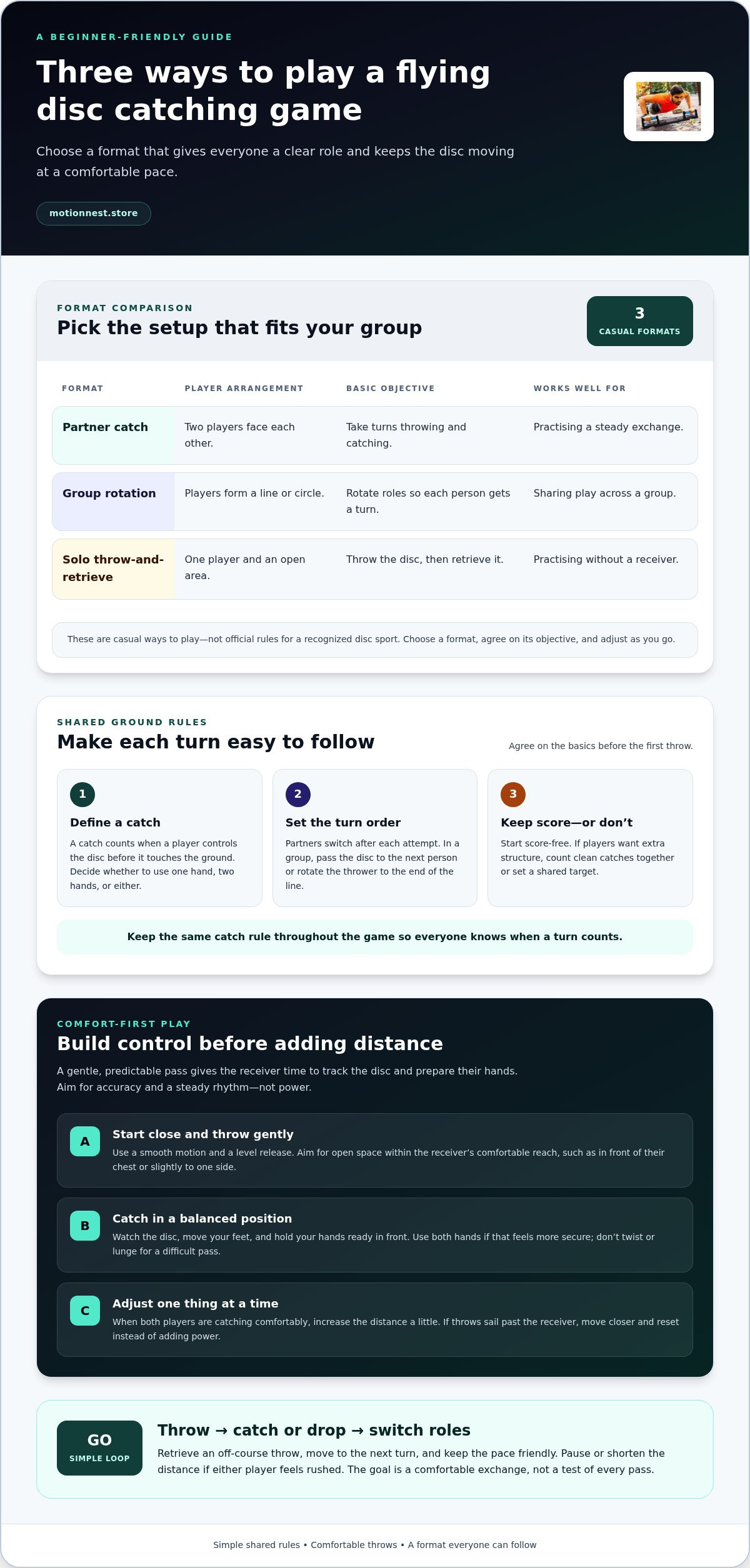
Choose a format that gives everyone a clear role and keeps play moving. Partner catch is a simple starting point. Group rotation includes more players, while solo throw-and-retrieve lets one person practise without a receiver. These are casual ways to play, not official rules for a recognized disc sport. Pick a format, agree on its objective, and adjust as you go.
| Format | Player arrangement | Basic objective | When it suits |
|---|---|---|---|
| Partner catch | Two players face each other | Take turns throwing and catching | Practising a steady exchange |
| Group rotation | Players form a line or circle | Rotate roles so each person gets a turn | Sharing play across a group |
| Solo throw-and-retrieve | One player and an open area | Throw the disc, then retrieve it | Practising alone |
Partner play: focus on a steady catch-and-throw rhythm
With two players, keep the exchange easy to follow: one throws, the other catches, then they switch roles. Try a relaxed sequence of catches rather than aiming for a score. If the disc regularly falls short or travels past the receiver, move closer together. If the exchange feels comfortable, increase the distance gradually. Aim for a rhythm both players can enjoy, not a streak that adds pressure.
Group or solo play: add turns without complicating the rules
For a group, set a rotation before the first throw. One simple option is for the thrower to pass to a receiver, then move to the end of the line while the next player takes a turn. In a circle, players can take turns throwing to the person beside them. Choose one pattern and keep it consistent so no one has to compete for a turn or guess who goes next.
Solo practice works differently. Choose a safe, open area, make a controlled throw, and walk to retrieve the disc. There’s no receiver, so it isn’t a shared catching game, but it can help you get used to throwing and tracking the disc before playing with a partner or group. Keep the throwing space clear and retrieve the disc before starting the next attempt.
Choose partner catch for a calm first exchange, group rotation when everyone wants a turn, or solo practice when playing alone. The same simple approach to how to play flying disc catching game works across these setups without formal scoring. If you’re exploring mini flying disc games, the Mini Flying Disc Catching Game buying guide offers another place to learn about them. Motion Nest’s Mini Flying Disc Catching Game is one option for trying the activity.
Start a flying disc catching game with a simple progression
A short routine makes it easier to begin without stopping to debate every turn. Before the first throw, agree on what counts as a catch and who throws first. Keep the opening round gentle, then use each exchange to decide whether to stay at the same level or add a small challenge.
- Agree on the catch rule. Decide whether a catch counts when the receiver controls the disc before it touches the ground.
- Begin close. Choose a comfortable distance and use gentle throws that are easy to follow.
- Trade turns. Switch thrower and receiver regularly so both players practise each role.
- Adjust together. If the exchange feels easy, change one part of the challenge. If it feels difficult, make the next attempt simpler.
If catches are missed repeatedly, don’t push through the same setup. Move closer or soften the throw, then try again. A short reset can help: retrieve the disc, take a breath, and agree on an easier target. Treat a missed catch as feedback about the throw or distance, not as a reason to rush the next turn.
A first round beginners can follow
Choose the shared catch rule and decide who starts as thrower. Stand at a distance that feels manageable for both players, then exchange gentle passes. Switch roles after each attempt, whether the throw is caught or dropped. Notice controlled throws and comfortable catches rather than focusing on who can send the disc farthest. This gives each beginner a clear way to take part.
Make the next round more challenging at a comfortable pace
When the exchange feels steady, change only one thing. You might move a little farther apart or ask the thrower to aim for a more specific target that remains comfortable to reach. Avoid changing distance and accuracy at the same time, since it can be hard to tell what made the game tougher. If players lose control or stop enjoying the round, return to the easier setup. Offer a new challenge as an option, not a requirement.
Start with easy exchanges, then add a challenge only when both players feel ready. This progression is a practical way to learn how to play flying disc catching game while keeping the pace friendly. Motion Nest’s Mini Flying Disc Catching Game is one option for trying the activity. Explore the Mini Flying Disc Catching Game as you plan a beginner-friendly round.
Keep the game welcoming, and try a mini flying disc format
A good catching game leaves room for different comfort levels. One player may be ready to move farther apart, while another may prefer short, easy exchanges. Keep the pace relaxed and let players adjust the setup together. The aim is to share the activity, not to make everyone throw or catch in exactly the same way.
Adapt turns and challenge for different comfort levels
Invite each player to say what distance feels manageable, then choose a starting point that works for everyone. If a throw is hard to follow, shorten the distance or slow the exchange. If it feels comfortable, players can decide together whether to add a little more challenge. Keep changes flexible and make it easy to return to a simpler setup.
Clear roles can also make group play more relaxed. Players can take turns as thrower and catcher, while someone else helps organize whose turn comes next. Rotate those roles so no one is left waiting or expected to do only one part of the game. In a larger group, a turn organizer can simply point out who goes next and keep the activity moving.
A missed catch is another chance to try. Retrieve the disc without blame, then let the thrower choose an easier pass or ask the receiver what would feel more comfortable. Players can take a short break or pass on a turn whenever they want. Small choices like these help keep participation friendly and pressure-free.
When to explore a mini flying disc catching game
A mini flying disc catching game can be a casual way to enjoy throwing and catching. The same shared approach to how to play flying disc catching game applies: set an easy pace, take turns, and adapt the challenge to the people playing. Choose an open area that suits the activity and conditions, and keep throws comfortable. A mini format doesn’t automatically make every location or setup right for every person, so use your judgment and adjust as needed.
Motion Nest offers the Mini Flying Disc Catching Game for anyone interested in trying this type of activity. Focus on comfortable participation rather than assuming a particular disc will suit every room, age, or playing condition. Start with a simple shared game, then let the group decide what feels enjoyable.
If you’d like to explore this option, take a look at the Mini Flying Disc Catching Game.
Make your next throw the start of a new routine
Your first game doesn’t need to be the last. Keep the disc handy for a relaxed break, invite someone to join, or set a small personal challenge for your next session. As you get more comfortable with how to play flying disc catching game, shape each round around what feels enjoyable that day.
Motion Nest sells the Mini Flying Disc Catching Game, with worldwide shipping and a money-back guarantee. Explore the Mini Flying Disc Catching Game and plan your next casual activity.
Take it at your own pace, enjoy the shared moments, and let every throw be another chance to have fun.
Frequently Asked Questions
Is a flying disc catching game the same as Ultimate Frisbee?
No. A casual catching game can be as simple as two people tossing a disc back and forth, while Ultimate is a team sport with its own rules, field setup, and scoring. If you’re learning how to play flying disc catching game informally, agree on a simple goal and turn order with the other players. Don’t assume casual play follows Ultimate rules unless that’s the game you’ve chosen.
Can you play a flying disc catching game without keeping score?
Yes. You can enjoy the exchange without tracking points or recording catches. If players want a shared goal, count how many successful passes the group makes before a drop, then start fresh without treating the result as a competition. You can also switch roles after each pass so everyone gets a chance to throw. Keep the goal optional and change it if it stops feeling fun.
How many people do you need for a flying disc catching game?
Two people are enough for a basic throw-and-catch exchange. With a larger group, decide on a simple rotation, such as passing to the next person in a circle or taking turns from a line. Solo practice is possible too: throw the disc into a clear area and retrieve it. That helps you get familiar with throwing, but it doesn’t provide the shared catch-and-throw exchange of playing with someone else.
What should beginners do if they keep dropping the disc?
Make the next attempt easier rather than throwing harder. Move closer, ask for a gentler pass, and keep watching the disc as it reaches your hands. A two-handed catch may feel more secure if the throw arrives within comfortable reach. If the disc keeps falling, pause and reset the exchange. There’s no need to add speed or distance until both players feel ready to continue.
Can adults and children play a flying disc catching game together?
Yes, adults and children can play together by choosing a pace and distance that feel comfortable for everyone. Let the less experienced player help set the challenge, and make it easy to ask for a softer or shorter throw. Start with passes that stay within easy reach, then adjust only if both players are comfortable. Keep difficult catches optional so taking part feels enjoyable rather than pressured.
How long should a round of a flying disc catching game last?
There’s no required length for a casual round. You might stop after everyone has had a turn, switch roles when it feels natural, or keep going while the group is enjoying the game. If players are waiting, agree on a simple endpoint, such as one turn per person before rotating again. A timer and formal scoring aren’t necessary for a relaxed game.
Do you need formal rules to play a flying disc catching game?
No. For casual play, the group can agree on a few basics before starting, such as who begins and how turns move between players. Add a shared goal only if everyone wants one. These choices help prevent mix-ups without requiring a formal rulebook. If you’re intending to play a recognized disc sport, use that sport’s rules rather than treating a casual variation as official.