
Could the handrail that looks most reassuring be the wrong support for your shower? Choosing a shower safety support handrail means considering who will use it, which movement needs support, and whether the shower surface suits the product.
A steady point of contact can feel helpful in a wet space, but suction-cup support has limits. Its hold depends on the surface and how it is prepared. Suction-cup models are intended for balance assistance, not full body-weight support. A handrail can be one part of a safer routine, but it cannot promise to prevent a fall.
This guide walks you through assessing the shower, defining the support needed for everyday balance, and checking product instructions before choosing. It also explains how Motion Nest’s Bathroom Handrail With Vacuum Sucker For Safety Support fits into the decision, so you can compare its stated use with your needs rather than assume more than its product information says.
Key Takeaways
- Match the support to the person, the movement, and the shower layout.
- Check that the surface offers a clean, smooth contact area, and follow product instructions on texture, grout lines, and moisture.
- A removable suction-cup handrail and a fixed grab bar serve different roles. Consider which type suits the task.
- Use a checklist to review the user’s needs, placement, surface conditions, instructions, and product limits.
- Compare Motion Nest’s Bathroom Handrail With Vacuum Sucker For Safety Support with your shower and intended use.
Start with the support you need from a shower safety handrail
Showering may feel less steady when balance, movement, or confidence changes. Instead of starting with which handrail looks sturdy, identify the particular movement that feels difficult. Support needs can vary between people and from one movement to the next.
A shower support handrail is a point of contact intended to assist with balance during shower-related movements, not a promise that falls will not happen. Light contact to steady yourself is different from pulling your body up, transferring between surfaces, or relying on a rail to hold your full weight. The appropriate role depends on the person, bathroom layout, and product design and instructions.
Consider where a handrail might be useful: near the shower entrance, beside a seat, or within reach while standing. Check whether the user can reach and grip it comfortably without twisting or stretching. General information about grab bars can explain how supports vary in style and use, but it cannot determine which option suits a particular person or bathroom.
Describe the need in practical terms: “I want a steadying touch while I turn,” or “I need support to move from sitting to standing.” These are different tasks. Moving from sitting to standing may involve transferring or bearing weight, so do not assume a removable handrail can provide the required support. Defining the movement makes it easier to compare the task with the product’s stated use.
Which shower movements feel difficult?
Consider each movement separately: stepping in, turning, standing, and reaching for soap or controls. Someone might feel steady while standing but uncertain when stepping over a threshold. Another person may enter comfortably but need help reaching without leaning. Naming the movement makes the decision specific and avoids assuming everyone needs the same assistance.
When might a suction-cup handrail not be the right support?
Suction-cup products have limits set by their design and instructions. They should not be treated as fall-arrest devices or relied on to catch someone who slips. If a person needs substantial help transferring, pulling themselves up, or supporting body weight, a removable rail may not be appropriate. Seek an assessment from a qualified health professional, such as an occupational therapist, to discuss suitable support.
Before choosing a shower safety support handrail, compare the product’s stated role with the movement it is meant to assist. If the need involves more than light balance support, pause and seek guidance suited to that level of assistance. Start with the person and task, not the handrail’s appearance.
How suction-cup shower handrails depend on the surface
A suction cup needs a suitable contact area to attach as intended. It must meet a surface that is clean, smooth, and even enough for the cup to sit flat. A wall that looks solid may still have details that interfere with contact. The word “tile” alone cannot establish whether a particular handrail is suitable.
Texture, grout lines, unevenness, dirt, and moisture can affect how well a suction cup meets the wall. For example, a cup placed partly over a grout line may not have an uninterrupted area beneath it. A textured finish or raised edge may also prevent an even seal. These are general considerations, not a compatibility verdict. Follow the instructions for the specific product you are considering.
Use a suction cup only on surfaces and in conditions allowed by its product instructions. Do not assume a handrail will attach securely just because the wall appears smooth or another suction product has worked there. Product designs and permitted uses differ, so use the guidance for the exact handrail.
What should you look for on the shower wall?
Look for a flat, uninterrupted area large enough for the suction cup or cups to sit as directed. Tile varies in finish and shape, while grout lines create gaps between tiles. Neither the word “tile” nor a glossy appearance guarantees compatibility. Before choosing a location, check the product’s surface requirements, placement directions, and preparation steps.
Consider the condition of the chosen spot, too. Soap residue, dust, or moisture may interfere with contact, so prepare the wall as the instructions direct rather than guessing. Do not place a cup across a seam, edge, or uneven feature unless the product directions specifically allow it. If no suitable area meets the stated requirements, that surface may not suit the handrail.
Why product instructions matter
Instructions are not interchangeable. Application, removal, and permitted-use steps can vary by product, so do not copy a setup method from another model. Follow the specified conditions for preparing the surface and positioning the cups. Avoid relying on generic online tips or making assumptions about weight limits, testing methods, or performance.
Keep the decision specific: compare the intended use with the product’s stated role, then compare its surface directions with your shower wall. If the stated conditions do not fit your bathroom, choose another support option rather than improvising. Motion Nest sells the Bathroom Handrail With Vacuum Sucker For Safety Support. Evaluate it against its product information and instructions, without assuming surface compatibility or support capacity beyond what they state.
Suction-cup handrail or fixed grab bar: which role fits?
Both options provide a place to reach for, but they work differently. A suction-cup handrail is removable and depends on a suitable surface and following its use conditions. A fixed grab bar is attached to the wall as a more permanent fixture, and its usefulness depends on the bar, its placement, and how it is installed.
Convenience does not make the two options interchangeable. A removable handrail may suit someone looking for temporary balance assistance if the product instructions fit the surface and intended use. Someone who needs to pull up, transfer, or bear substantial weight needs a different level of support. Do not assume a suction-cup product is made for that task simply because it feels solid when touched.
What can a suction-cup option offer?
As a category, suction-cup handrails can be removed and repositioned. This may be useful when a fixed location is not wanted or when different users need support in different places. Those features do not establish how well a specific item will attach or what loads it can support. Follow the product directions for placement, surface conditions, application, and permitted use.
Consider the task as well. A user might want a light touch while reaching for a control, rather than a rail to hold their weight. If that limited role matches the product’s instructions, a removable option may be worth evaluating. Portability describes where an item can be used, not whether it suits every wall or support need.
When should a fixed support be considered?
If someone needs substantial support to stand up, transfer, or steady their full weight, do not count on a suction-cup handrail to meet that need. A properly selected and securely installed fixed grab bar involves different structural and installation considerations. Its position should suit the movement it is meant to assist, not simply the room’s appearance.
For example, support beside a shower seat may need to be positioned differently from support used while entering or exiting. The user’s reach, grip, movement, and bathroom layout all affect the choice. If the amount or type of assistance is unclear, an appropriate assessment can help identify the support needed before choosing a product.
Use these distinctions to compare the options:
- Installation: A suction-cup model attaches to a suitable surface according to its instructions. A fixed bar must be mounted securely to the wall structure.
- Portability: A suction-cup model is removable by design. A fixed bar is intended to stay in its installed position.
- Intended role: Suction-cup products are generally for balance assistance. A fixed bar may suit greater support when the product and installation are designed for that use.
Match the support type to the person’s assessed need, not just to the easiest setup. Consider a shower safety support handrail only for the role its design and directions describe. Removable convenience does not establish weight-bearing suitability, and a fixed bar is not automatically right unless properly selected, positioned, and installed.
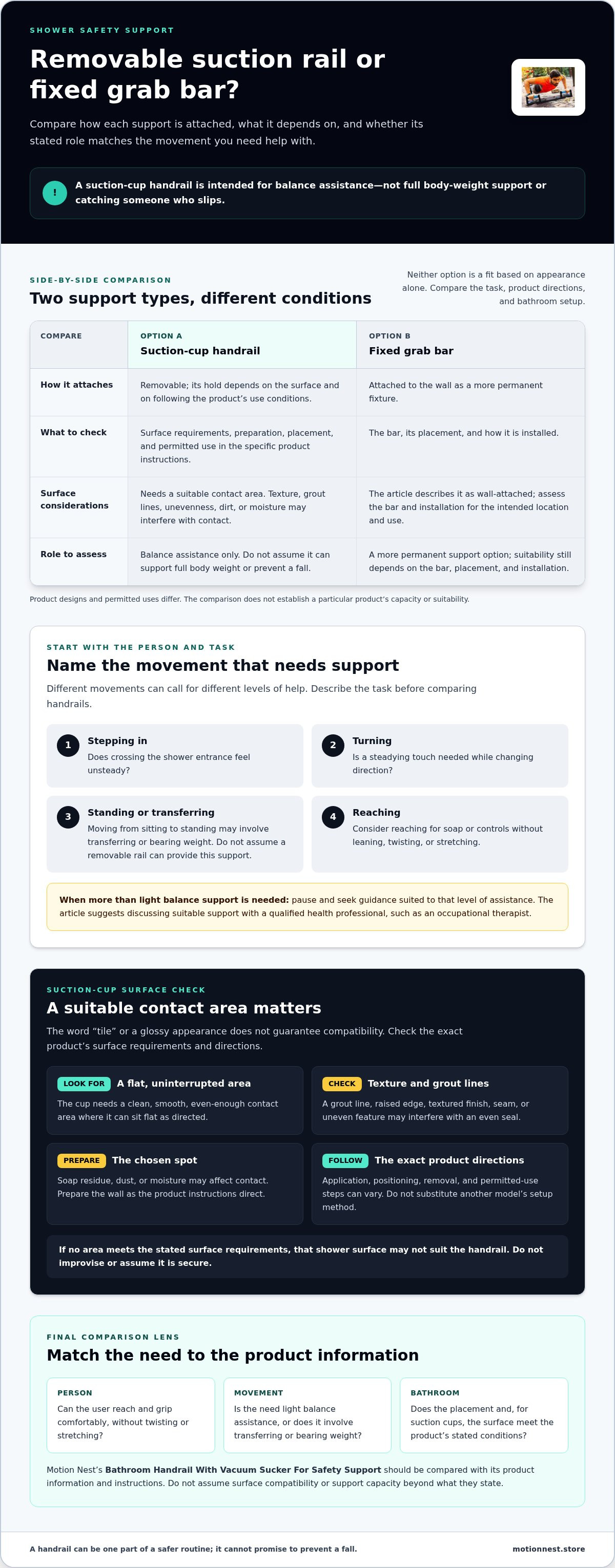
Use this checklist before choosing a shower safety support handrail
Planning makes it easier to compare the support needed with the surface, instructions, and intended role of a handrail. Use these questions as a selection checklist. They do not replace following the product directions during setup and use.
Questions about the person and intended task
Start with the person who will use the handrail and the movement they want help with. Light contact for balance is different from lifting, transferring, or supporting body weight. Specify the task, such as reaching while standing or moving from a seat. If the expected support goes beyond balance assistance, pause before considering a removable suction-cup option.
Questions about the shower and product guidance
Compare the intended mounting area with the manufacturer’s surface requirements. Check the instructions for placement, surface preparation, and permitted use. Do not assume a surface is suitable based on its material or appearance alone. If the wall conditions or the user’s needs do not match the directions, reconsider the choice rather than adapting the setup.
- What movement needs support? Identify the task, such as stepping in, turning, standing, or reaching. This helps define the type of support needed.
- How much assistance is expected? Decide whether the user needs a light point of contact for confidence or balance, or support for lifting or transferring. These are different roles.
- Can the user follow the instructions? Consider whether the person can apply and use the handrail as directed, including any steps or conditions stated by the manufacturer.
- Does the mounting area meet the product’s surface requirements? Compare the exact location with the instructions. Look for surface features that may conflict with the stated conditions.
- Do placement and permitted use fit the task? Check where the handrail can be positioned and what kind of use the product allows. Do not infer a support role the directions do not describe.
- What are the product’s limits? Review its stated use and limitations. If the guidance does not fit the person, task, or shower, stop and consider a different support approach.
Quick summary: Identify the movement, define the level of support, check that the user can follow the directions, match the surface and placement to the manufacturer’s requirements, and stay within the product’s stated limits. If any part does not fit, do not proceed on assumption alone.
After working through the checklist, compare your needs and shower surface with Motion Nest’s Bathroom Handrail With Vacuum Sucker For Safety Support and its product guidance. Choose it only if the stated conditions suit the intended use.
Consider Motion Nest's shower safety support handrail with care
Motion Nest sells the Bathroom Handrail With Vacuum Sucker For Safety Support for people exploring bathroom support options. A product name alone cannot tell you whether it suits a particular person, shower wall, or movement. Compare the product information with the need you identified before deciding.
What to review on the product listing
Read the product listing and any supplied instructions for its stated use, setup, surface guidance, and limits. Match that guidance to the intended task. For example, if the goal is a light touch for balance, make sure the stated role fits. Do not infer that the handrail is suitable for lifting, transferring, or bearing body weight unless the product information explicitly says so.
Pay attention to the shower surface guidance. Compare the wall area you are considering with the conditions described in the product materials. Do not rely on a general assumption about tile or a surface that looks smooth. If the instructions do not cover your intended surface or use, pause rather than treating uncertainty as approval.
A thoughtful next step for your bathroom
Ground the decision in three things: the task the user needs help with, the surface where the handrail would be placed, and the product’s stated limits. If any of these do not align, the handrail may not be the right support for that situation. When the person needs substantial assistance, consider an appropriate assessment before choosing a support option.
This approach keeps the choice practical without asking one product to do more than its instructions describe. A shower safety support handrail can be part of a bathroom routine, but it cannot promise to prevent a fall. Use the product information and instructions to understand its role, then decide whether it fits your needs.
For a closer look, explore Motion Nest's bathroom handrail and review the product information at your own pace. Motion Nest advertises worldwide shipping and a money-back guarantee. These store details do not add product specifications or change the handrail’s stated use, so let the listing and instructions guide your decision.
Make your next step a considered one
A support choice should fit the person’s needs, not just look convenient in the bathroom. Weigh the intended use against the product guidance, and do not feel pressured to choose if the details do not fit. Make the decision with a clear understanding of the support offered and its limits.
If a suction-cup option seems appropriate to explore, Motion Nest sells the Bathroom Handrail With Vacuum Sucker For Safety Support. The store advertises worldwide shipping and a money-back guarantee. Review the published terms as you browse. These store details do not replace product-specific instructions or establish how the handrail will work in your shower.
Keep the person and intended task at the center of your choice. Explore Motion Nest's bathroom handrail and review its product information before deciding whether it suits your needs.
Frequently Asked Questions
Can a suction-cup shower handrail be installed over grout?
Usually, a suction cup should not cross a grout line unless the product instructions specifically allow it. A groove can interrupt the cup’s contact with the wall. Look for a spot where the entire cup can sit on a suitable tile, away from grout, tile edges, and decorative ridges. If the wall does not offer a placement that follows the instructions, do not force a fit.
Can I move a suction-cup handrail between different shower walls?
Only if the product instructions allow removal and reapplication and each new wall meets the stated surface requirements. A different wall may have a different finish, grout layout, slope, or condition, even in the same shower. Do not assume that an attachment that worked in one spot will work in another. Follow the product directions each time you relocate it.
How often should I replace a suction-cup bathroom handrail?
There is no replacement interval that applies to every model. Follow the manufacturer’s guidance, and stop using the handrail if a cup, locking part, or other component appears cracked, warped, torn, or otherwise damaged. Age alone does not tell you whether a product remains suitable. If the instructions give a replacement schedule or wear criteria, follow them rather than guessing.
Can a suction-cup handrail damage or mark bathroom tile?
It may leave marks or residue, depending on the handrail, tile finish, and cleaning products used. Before placing it, read the manufacturer’s care and removal guidance, especially if the tile has a delicate or decorative finish. Avoid scraping or using harsh cleaners unless the tile and product instructions permit them. If you are concerned about the finish, choose a location or support option that suits it.
Are suction-cup grab bars ADA-compliant?
No. Suction-cup grab bars do not meet ADA standards and are not designed to support a person’s full body weight. They are intended for balance assistance, not as a substitute for a fixed grab bar designed and installed for weight-bearing support. A product label alone does not establish that an installation meets accessibility requirements. If you need that level of support, consider an appropriate fixed option.
Can I use a suction-cup handrail outside the shower?
Only if the product instructions permit use in that location and the surface meets its requirements. A bathroom wall outside the shower may still be textured, uneven, or unsuitable for the cups. Consider whether the location exposes the handrail to conditions the directions do not allow. Do not extend a product’s use beyond its stated purpose based only on appearance or convenience.
What should I do if a suction cup will not attach securely?
Do not use the handrail or lean on it. Remove it according to its instructions, then check whether the surface and preparation match the product guidance. Try another location only if it meets those requirements. If it still will not attach as directed, stop using that setup and choose a support option suited to the person’s needs and bathroom. Never rely on a shower safety support handrail when attachment is uncertain.
To review Motion Nest’s Bathroom Handrail With Vacuum Sucker For Safety Support, explore the product information and compare its stated use with your shower and support needs.