
A push-up board may add options, but it won’t automatically make your workout better. In the push up board versus floor push ups comparison, the right choice depends on what feels comfortable, fits your space, and helps you keep moving consistently.
It’s fair to wonder whether a board is worth adding when floor push-ups need no equipment. A board can offer guided hand positions and a more structured setup, while floor push-ups keep the movement simple and flexible. Neither option is right for everyone, and your current ability matters as much as your goals.
This guide compares comfort, movement options, convenience, and training fit so you can choose with confidence. You’ll also learn what to consider before buying a coded push-up board, including whether its setup suits your routine. If you prefer an equipment-based approach, Motion Nest’s Coded Push Up Muscle Board is one option to explore as you weigh the trade-offs.
Key Takeaways
- Understand what changes in the push up board versus floor push ups, from hand placement to workout setup.
- Compare guidance, movement options, storage needs, and flexibility to see which setup fits your routine.
- Match your choice to your current ability, goals, and preference for equipment or a minimal setup.
- Use a simple decision process to weigh your space and whether you already enjoy floor push-ups.
- See whether Motion Nest’s Coded Push Up Muscle Board suits your preference for a structured, equipment-based routine.
Push-Up Board Versus Floor Push-Ups: What Actually Changes?
A floor push-up is a bodyweight repetition performed with your hands directly on the floor; a push-up board is equipment that organizes hand placement or exercise variations. Both use a pushing motion, but the setup and the amount of guidance can differ. The board gives you a defined surface to work with, while the floor leaves you free to place your hands where they feel appropriate.
That distinction is the heart of push up board versus floor push ups. The board adds equipment and structure, not a wholly different kind of exercise. Your choice affects how you set up, adjust your hand position, and fit push-ups into your space.
How the two push-up setups differ
Floor push-ups are ready wherever you have enough clear floor space. There’s no equipment to bring out or put away, and you can change your hand placement without following a board’s layout. This suits quick sessions and routines that keep gear to a minimum.
A board takes an extra setup step: position the equipment, then use its layout to guide your hands or choose a variation. That can feel more structured if you prefer a visual reference. It also means setting aside storage space. A board can be moved between sessions, but it still needs a place when you’re done.
- Equipment: Floor push-ups need no dedicated board; board exercises use an additional piece of equipment.
- Setup: The floor is ready to use, while a board needs to be placed before you start.
- Hand placement: A board can organize options; the floor lets you choose your own positions.
- Storage: Floor push-ups need no gear storage, while a board needs space between workouts.
What stays the same in the movement
With either setup, you lower and press your body using a controlled pushing pattern. The chest, shoulders, and triceps are commonly involved. A board may help organize hand positions, but it doesn’t do the work for you or replace steady movement and effort.
Your body position still matters. Keep your movements deliberate and choose a version you can perform with control. Hand placement can change how a push-up feels and which muscles contribute more, but no single setup makes good form automatic. For a broader overview of muscles worked during a push-up and common variations, see Wikipedia’s push-up article.
So, the practical difference is the setup around the exercise. The floor offers a flexible, equipment-free option. A board offers a more organized starting point for hand placement. Both remain push-ups, and the better fit depends on the way you want to approach your routine.
Push-Up Board vs. Floor Push-Ups: Compare the Workout Experience
The biggest difference is how each setup guides your choices. A board can make hand-placement options easier to follow, while floor push-ups leave you to choose your position without a dedicated guide. Neither setup automatically makes a repetition easier or more effective. Exercise difficulty depends on the variation you perform, your range of motion, and your current ability.
Equipment changes the setup, not the need for sound form. Move with control, choose a range you can manage, and adjust the exercise to suit your ability, whether your hands are on a board or the floor.
Where a push-up board may feel more structured
A board can make different hand-placement options easier to see at a glance. That defined starting point may suit you if choosing a position on your own feels uncertain, or if you enjoy following a consistent setup between sessions. Board designs vary, so treat these as general category observations, not claims about every model. Motion Nest’s Coded Push Up Muscle Board is an option for people drawn to an equipment-based routine.
Where floor push-ups offer more flexibility
Floor push-ups keep the setup simple: find a clear patch of floor and begin. You can adjust your hand position or body position without relying on a board’s layout, then practice wherever you have enough room. That freedom can be useful if you like to experiment with your setup or don’t want another item to store. The trade-off is that you choose each position yourself.
So, in the push up board versus floor push ups comparison, think about what helps you get started and stay comfortable. If visible guidance appeals to you, explore the Coded Push Up Muscle Board as one equipment-based option. If you value a no-equipment routine and flexible hand placement, floor push-ups may suit your preferences better.
Which Suits Your Goals: A Push-Up Board or the Floor?
The better choice is the setup you’ll use comfortably and consistently. A board can add a sense of structure, while floor push-ups keep your routine simple and adaptable. Neither is required for progress, and neither guarantees faster strength gains. Think about your experience, available storage, and what helps you feel ready to begin.
When a board may fit your routine
A board may suit you if visible placement options help you organize a workout or make choosing a hand position feel less uncertain. Beginners can appreciate having a defined starting point, but the board doesn’t replace learning controlled movement or choosing a manageable variation. Experienced exercisers may enjoy having equipment as part of their routine, though it isn’t automatically more challenging.
Consider your habits, too. If setting up a piece of equipment makes exercise feel more engaging, that small ritual may help you look forward to a session. If bringing it out feels like extra work, it could become one more barrier. A board is an option, not a requirement.
When floor push-ups may be the better fit
Choose the floor if you value a minimal setup, limited storage, or the freedom to exercise without dedicated equipment. You can adjust your hand position and choose a familiar variation to match your current ability. Beginners and experienced exercisers alike can use floor variations as a starting point and adapt their practice over time.
Comfort matters more than the tool. Whichever setup you choose, use a range of motion and pace you can control. If a position feels uncomfortable or your form becomes difficult to maintain, pause and reassess rather than forcing repetitions.
Use these preferences as a quick guide:
- New to push-ups: Pick the setup that feels easiest to understand, then focus on controlled repetitions. A board may offer structure, but you can also start with a familiar floor variation.
- Experienced exerciser: Choose based on the kind of routine you enjoy. A board can introduce a defined equipment-based setup; the floor leaves more room to adjust your own hand position.
- Limited storage: Floor push-ups avoid adding equipment to your home and are ready wherever you have clear space.
- Minimal-equipment routine: The floor is a natural fit if you prefer to keep workouts simple and gear-free.
- Motivated by a set routine: A board may appeal if having equipment helps you feel organized and ready to exercise.
For the push up board versus floor push ups decision, weigh structure against flexibility, then consider convenience. If a board makes your routine feel more inviting, it may be worth exploring. If you prefer a simple setup that adapts easily, the floor may fit better. Let your comfort and ability guide the choice, not the idea that one method is best for everyone.
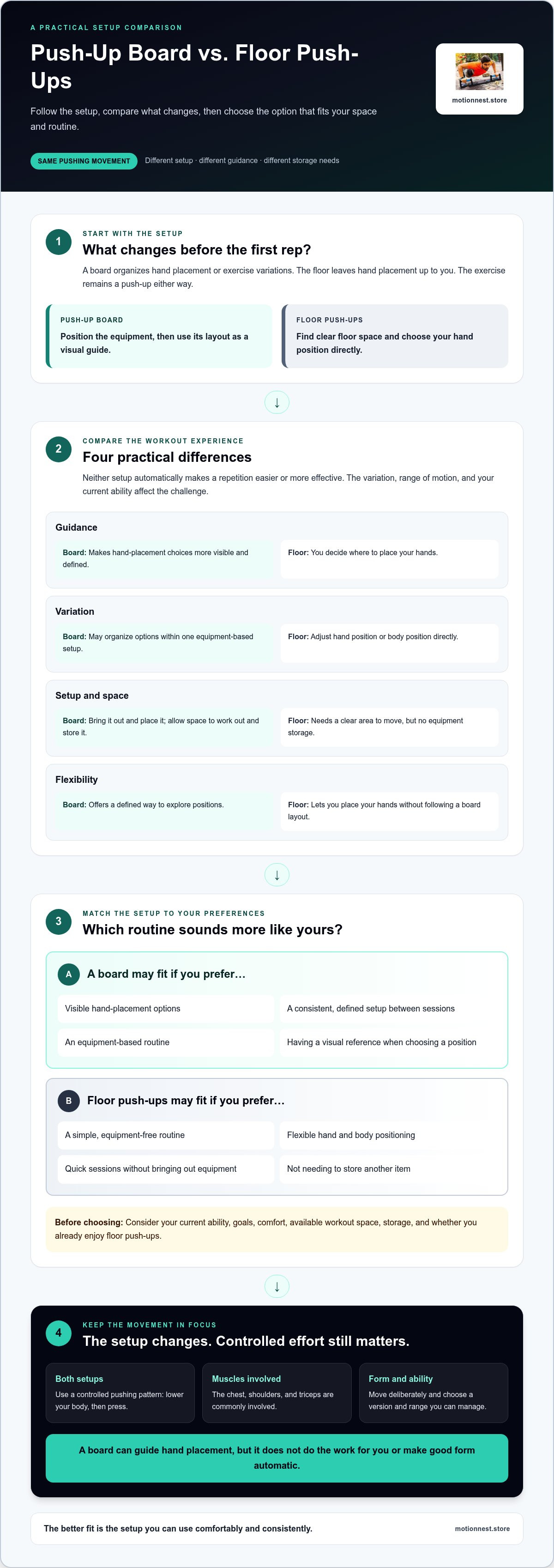
How to Choose Between a Push-Up Board and Floor Push-Ups
A simple decision process can help you choose without overthinking the equipment. Start with the push-up routine you already enjoy, then consider your space and whether guided placement would make workouts easier to follow. The goal is to find a setup you can use comfortably, not to add complexity for its own sake.
A quick checklist for your workout space and habits
Think about where you usually exercise. Do you have a clear, stable area where you can move safely? Is there a convenient place to store a board between sessions? Also consider whether getting equipment ready feels motivating or like one more step that might interrupt your routine.
If you already enjoy floor push-ups, begin with that familiar setup. If you’d like more guidance, a board could be worth exploring. Either way, start with the simplest comfortable option and focus on controlled movement before adding new variations.
Questions to ask before choosing equipment
- Do you enjoy floor push-ups already? If yes, consider whether you want a new setup or are happy with the flexibility you have. If not, think about what might make the movement feel more approachable.
- Would guided choices help? A board may appeal if you prefer a defined setup. If you want to place your hands freely, the floor keeps that choice open.
- What will fit your routine? Consider where you’ll exercise, how much storage you have, and whether you expect to use the equipment regularly.
- Which variations will you actually practice? Choose based on the movements you can perform with control and expect to return to, not on the number of options a setup appears to offer.
Try a comfortable floor variation first if you’re unsure. Notice whether the setup feels manageable and whether you can keep your movement controlled. If you want more direction after that, learning the basics in this beginner push-up board guide can help you understand how to use a board. It focuses on use instructions, while your choice should still reflect your preferences and workout space.
Thinking about buying one? The coded push-up board buying guide offers broader purchase considerations. Keep your priorities clear: a defined setup, room to store equipment, and the kinds of variations you expect to practice. You don’t need to buy a board to do push-ups, but the right equipment-based option may suit you if structure helps you feel ready to begin.
Use the push up board versus floor push ups comparison to match the setup to your goals, space, and preferred level of guidance. If an equipment-based routine sounds like a better fit, explore Motion Nest’s Coded Push Up Muscle Board as a structured option.
Explore Motion Nest’s Coded Push Up Muscle Board
If you prefer having equipment as part of your workout, Motion Nest’s Coded Push Up Muscle Board is a relevant option to consider. It gives you a way to explore an equipment-based push-up routine rather than relying only on the floor. The product name identifies it as a coded push-up board, but your decision should still rest on whether you want a board in your routine, not on assumptions about specific layouts or results.
How the coded board fits the comparison
A coded board may appeal if you like the idea of a more structured setup and want to explore guided choices. Floor push-ups remain a practical alternative: they need no dedicated equipment and let you choose your hand position directly. A board doesn’t automatically improve technique or make an exercise more effective. Your comfort, body position, and control still matter.
Consider what you want your workout space to feel like. If bringing out equipment helps you settle into a planned session, a board may feel like a useful addition. If you prefer to start with minimal preparation, floor push-ups may fit more naturally. Neither choice needs to be permanent. You can begin with the setup you already have and decide whether a different format would make your routine more appealing.
It can help to think through the everyday details before choosing:
- Routine: Would equipment make you more interested in starting, or would setting it up feel like an extra task?
- Space: Do you have a comfortable workout area and a place to keep a board?
- Preference: Do you enjoy following a more organized setup, or do you like choosing your own hand placement?
- Comfort: Can you move with control and use a position that feels manageable?
A simple next step for interested shoppers
Choose the approach you can use comfortably and return to consistently. If floor push-ups already suit you, there’s no need to add equipment just to make the exercise feel more advanced. If you’re curious about a structured, equipment-based option, Motion Nest’s board offers a product to explore without committing to a particular training outcome.
That keeps the push up board versus floor push ups choice grounded in your preferences. A board can be appealing if you want equipment in your routine; the floor can be a better match if simplicity and flexibility matter more. Motion Nest advertises worldwide shipping and a money-back guarantee. You can explore the Coded Push Up Muscle Board and decide whether it suits the way you like to exercise.
Make Your Next Push-Up Session Your Own
Your next step doesn’t need to be a major change. Start with the setup that feels comfortable, then notice whether it makes you want to return for another session. The right choice in the push up board versus floor push ups comes down to what supports your routine, not what promises the most.
If you’re drawn to an equipment-based approach, Motion Nest sells the Coded Push Up Muscle Board as an option to explore. The store advertises worldwide shipping and a money-back guarantee. Take a look at the product details and decide whether it feels like a useful fit for your home workout space.
Explore Motion Nest’s Coded Push Up Muscle Board when you’re ready. Whatever setup you choose, a comfortable routine you can stick with is a positive place to begin.
Frequently Asked Questions
Is a push-up board better than floor push-ups?
Neither is universally better; the push up board versus floor push ups choice depends on the experience you prefer. A board can offer a more guided arrangement, while the floor gives you freedom to position your hands without equipment. For example, a set routine may feel easier to follow with a board, while a shared workout space may call for a setup you can adjust quickly. Pick what feels practical and comfortable.
Can beginners do push-ups on the floor without a board?
Yes, beginners can start on the floor without a board. Choose a manageable variation, such as wall push-ups or push-ups with your hands on a sturdy, stable raised surface. Focus on smooth repetitions rather than doing as many as possible. If you can keep your body aligned and lower and press with control, you have a useful starting point. Adjust the variation if you struggle to maintain that control.
Do push-up boards work different muscles than floor push-ups?
Not by equipment alone. The muscles involved depend more on hand position and the variation you perform than on whether you use a board. A narrower hand position may make the triceps feel more involved, while a different position can change how the movement feels across your upper body. Treat a board as a way to organize setup choices, not as a guarantee that a particular muscle will work harder.
Are push-up boards suitable for small home workout spaces?
They can be, if you have room to use the board safely and a convenient place to store it afterward. Check the product’s listed dimensions and consider where it will live between workouts, rather than assuming all boards take up the same space. If storage is tight, try floor push-ups first. They avoid storing equipment, though you’ll still need enough clear floor area to move comfortably.
Can I switch between a push-up board and floor push-ups?
Yes, you can use either setup across different workouts. For instance, choose the floor when you want to keep a session simple, then use a board another day if you prefer its organized format. Keep the variation and effort suitable for how you feel that day. Switching setups doesn’t require a complicated plan; pay attention to comfort and maintain controlled repetitions in either format.
Do push-up boards make push-ups easier?
Not necessarily. A board changes the setup and may make hand-placement choices more apparent, but it doesn’t automatically reduce the effort of a repetition. Difficulty depends on the variation, your range of motion, and your current ability. A position that feels manageable to one person may feel challenging to another. Start with a version you can control, then adjust the movement if your form becomes difficult to maintain.
What should I look for in a coded push-up board?
Look for a board that suits the routine you expect to follow and whose coded options are easy for you to understand. Consider how you’ll store it and whether its listed details fit your available workout space. Read the product information carefully so you know what the specific board includes, rather than assuming every coded board is alike. Motion Nest offers a Coded Push Up Muscle Board for shoppers considering an equipment-based setup.