
A handrail that installs without drilling can be useful, but it is not right for every bathroom or support need. Before you buy suction cup bathroom handrail options, consider the mounting surface and how you intend to use the product. Suction cups need a smooth, nonporous surface, and these handrails are intended to assist with balance, not support full body weight. They can also detach.
A removable support may appeal if you want to avoid drilling or prefer a product you can take down. However, a suction-cup handrail is not a substitute for a permanently installed grab bar when you need dependable, weight-bearing support. Motion Nest sells the Bathroom Handrail With Vacuum Sucker For Safety Support, a suction-based option with the same surface and use limitations to consider.
This guide explains how to assess your bathroom surface, distinguish balance assistance from fixed support, and compare product details with your intended use. These checks can help you decide whether a removable handrail fits your bathroom and routine.
Key Takeaways
- Before you buy suction cup bathroom handrail options, match the type of support to your intended use, not just the product’s appearance.
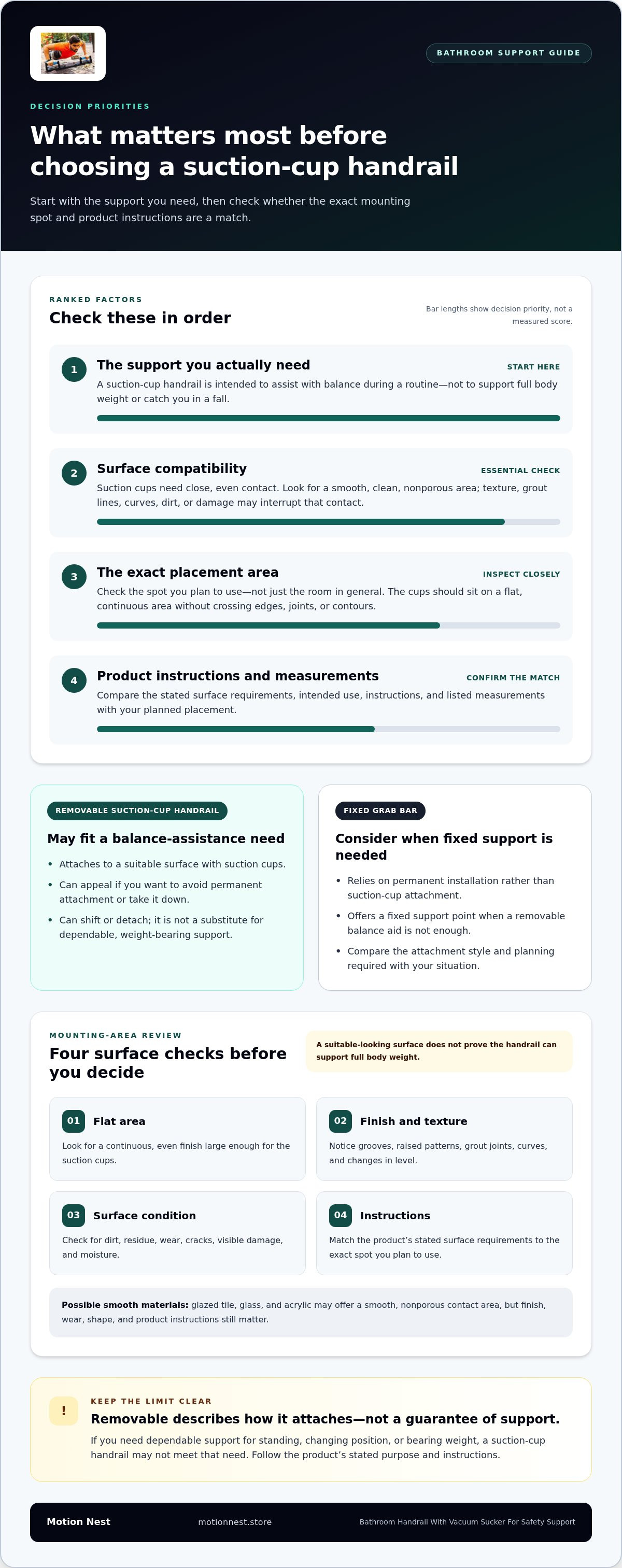
- Check that the mounting area is smooth, clean, nonporous, and free of grout lines so the suction cups can make contact.
- Compare removable and fixed grab bars by how they attach, where they can be placed, and what planning each option requires.
- Review the product’s listed measurements and instructions, then compare them with your intended placement area.
- Consider Motion Nest’s Bathroom Handrail With Vacuum Sucker For Safety Support alongside these checks.
Buy a Suction Cup Bathroom Handrail: Start With the Support You Need
A suction-cup bathroom handrail is a removable aid that attaches to a surface with suction cups. Whether it suits you depends on that surface and the support you need. Start there when you compare options. A product’s appearance may catch your eye, but its intended use should guide your choice.
Think about the moment you want support. Do you need a handhold to steady yourself during an everyday bathroom routine, or a fixed point to rely on while standing or changing position? Those are different needs. A suction-cup model is not automatically equivalent to a structurally fixed grab bar, and it should not be treated as support for full body weight or for catching yourself in a fall.
Who might consider a removable bathroom support handrail?
A removable handrail may appeal if you want a handhold for balance during a routine, prefer not to attach something permanently, or expect to reposition or take it down. Needs vary, so compare the product’s stated purpose with the task you have in mind. If the stated purpose does not meet your support needs, convenience alone is not a good reason to choose it.
What suction-cup support can and cannot mean
A suction cup presses against a surface to create a seal. The seal depends on contact between the cup and the surface. You can learn more about how suction cups work and why their design relies on that contact. The attachment method alone does not tell you how much support a particular handrail can provide.
“Removable” describes how a product attaches, not a guarantee of dependable support in every situation. A suction-cup handrail can shift or detach, so do not use one as a substitute for a fixed grab bar if you need a support point designed to bear weight. If balance assistance is not enough for your needs, a removable model may not be the right fit.
Before comparing options, describe the task you want help with. You may want a handhold nearby during a routine, rather than structural support for transferring or recovering from a loss of balance. Look for product information and instructions that clearly state the intended use and limits. If those do not align with your needs, do not let appearance or convenience outweigh that mismatch.
Include the bathroom in your decision. A suction-cup product depends on a suitable mounting surface, while a fixed grab bar relies on permanent installation. Neither attachment style suits every situation. Your support needs, placement plans, and the product instructions together offer a clearer basis for comparison than a product photo alone.
How Suction Cups Meet Bathroom Surfaces: Why the Surface Matters
A suction cup needs close, even contact with a surface to form a seal. Smooth, clean, nonporous materials are more likely to provide that contact than textured or uneven ones. Surface compatibility is a key buying consideration, so assess it before choosing a handrail.
Bathroom surfaces can vary even within the same room. One wall may have flat glazed tile, while another has textured tile, grout joints, or a decorative finish. A surface that looks smooth from a distance may have ridges or small imperfections that interrupt contact. Before you buy suction cup bathroom handrail options, compare the exact spot you have in mind with the product’s installation instructions.
Which bathroom surfaces deserve a closer look?
Glazed tile, glass, and acrylic are common examples of surfaces that may offer a smooth, nonporous contact area. They are not automatic guarantees of compatibility. Finish, wear, and the product’s instructions also matter. Look closely at the intended placement and check for a flat area large enough for the suction cups to sit without crossing edges, joints, or contours.
Textured finishes need extra care. Raised patterns, pebbled surfaces, and uneven panels can leave small gaps under a cup, making an even seal harder to form. Acrylic surfaces can also vary in shape and finish, so do not assume every panel is suitable. Compare the surface in your bathroom with the handrail’s stated requirements.
Why grout lines and surface condition matter
Grout sits lower than the tile face, so a cup placed across a grout line may not rest evenly on one continuous surface. Dirt or residue can also come between the cup and the wall. Moisture and visible damage may change the attachment conditions. Check these details before purchase rather than relying on the surface’s appearance alone.
Use this quick surface review as you compare your options:
- Look for a flat area: Check whether the planned location has a continuous, even finish.
- Check the finish: Look for texture, grooves, grout joints, curves, or other changes in level.
- Notice the condition: Look for residue, wear, cracks, or other damage that could affect contact.
- Read the product instructions: Compare the stated surface requirements with the exact area where you plan to place the handrail.
This review can help you assess the surface, but it does not establish how much support a handrail can provide. Follow the product’s instructions for its intended use, and do not treat a suitable-looking surface as proof that a removable product can support full body weight.
If the mounting area appears to meet the stated requirements, compare it with Motion Nest’s Bathroom Handrail With Vacuum Sucker For Safety Support. Assess the product’s intended use as well as the surface.
Suction-Cup Handrail vs. Fixed Grab Bar: Which Fits Your Situation?
A suction-cup handrail is removable and depends on the surface; a fixed grab bar is attached permanently and needs suitable installation. They are different support options, not interchangeable versions of the same product. Compare them according to your intended use, the surface or wall, and the level of support you need.
Suction attachment should not be assumed to provide structural support. A suction-cup product may be intended for balance assistance, but that does not mean it can hold full body weight or support someone during a fall. Read the product’s stated purpose and limitations before deciding whether it fits your needs.
| What to compare | Suction-cup handrail | Fixed grab bar |
|---|---|---|
| Attachment | Uses suction cups against a compatible surface. | Attaches permanently to a wall through an installation method suited to the location. |
| Removability | Designed to be removable; follow the product instructions for use and repositioning. | Stays in place unless removed through further work. |
| Surface needs | Needs a surface that meets the product’s stated requirements. | Requires a suitable wall and secure installation. |
| Planning | Check intended use, placement, surface, and instructions. | Plan the location and installation around the support needed. |
When a removable suction-cup handrail may be worth considering
Removability can be practical if you want a non-permanent option or need to take the handrail down. But easy removal does not prove that the product suits your bathroom or support needs. Before you buy suction cup bathroom handrail options, match the stated purpose to the task you have in mind and check that the planned surface meets the product’s instructions.
When fixed support may be a better fit
A fixed grab bar is a different product category. It is installed as permanent support, so the wall, location, and installation approach matter. If you need dependable weight-bearing support, do not assume a suction-cup handrail can provide it. For personal mobility or safety concerns, seek guidance from an appropriate health professional about the type of support that fits your situation.
Neither option is right for every bathroom or every person. A removable aid may suit one purpose, while someone who relies on a secure support point may need a different solution. Compare the product’s stated use with the real task, such as steadying yourself or bearing weight. If the purpose or limits are unclear, do not guess. That distinction can help you narrow your choices before comparing individual products.
A Practical Checklist Before You Buy a Suction Cup Bathroom Handrail
A checklist helps you compare product information with your bathroom and routine. Before you buy suction cup bathroom handrail options, review these five points in order. If an important detail does not match your needs, pause rather than relying on appearance or assumptions.
Five details to review in the product information
Read the listing and instructions together. The listing helps you compare product details, while the instructions explain how the handrail is meant to be placed, used, and cared for. Keep your intended location and use in mind as you work through each check.
- Define the intended use. Identify the specific routine or movement where you want a handhold. Compare that need with the product’s stated purpose, and do not treat balance assistance as weight-bearing support.
- Inspect the planned surface. Look closely at the exact spot where you plan to place the handrail. Check the finish, condition, grout lines, and any curves against the product’s surface requirements.
- Review the dimensions. Compare every listed measurement with the available placement area. Consider nearby edges, fixtures, and the space needed to position the handrail as directed. A product that does not fit the intended spot may not work for your layout.
- Read installation and care instructions. Note how the product is meant to be attached and maintained. Use the instructions for initial placement and later care rather than substituting general tips for directions specific to the handrail.
- Assess limits before deciding. Read warnings and stated restrictions carefully. If the product’s limits do not fit the support you need, choose a different type of support rather than expecting a removable handrail to do more.
Match the product to your routine and expectations
Think about who will use the handrail, where they will reach for it, and what kind of support they expect. Someone seeking a removable handhold for a specific routine may have different needs from someone who relies on a fixed support point. Base your comparison on the task, not just convenience.
After purchase, follow the product’s own instructions each time you place, use, or care for it. Do not assume one successful attachment means it will remain suitable in different conditions or locations. Treat stated limits as part of your decision, not fine print to overlook.
A separate guide to checking a suction-cup handrail can offer more detail on reviewing its placement and condition. For now, use the product’s instructions as your guide, and do not rely on a removable option where you need fixed, weight-bearing support.
Once you have compared your intended use, placement area, and product information, explore Motion Nest’s Bathroom Handrail With Vacuum Sucker For Safety Support.
Explore the Motion Nest Bathroom Handrail With Vacuum Sucker
After considering your support needs, bathroom surface, and product checklist, review a specific option. Motion Nest sells the Bathroom Handrail With Vacuum Sucker For Safety Support. As with any suction-cup handrail, consider whether the product’s stated purpose and instructions fit your intended use. The name alone does not establish how much support it provides or whether it suits every bathroom.
What to review on the Motion Nest product page
Read the Motion Nest product listing and instructions before making a purchase. Compare the description, stated use, and installation guidance with your checklist. For example, consider whether the instructions suit your planned placement and whether any listed measurements fit the space.
Keep the product’s stated purpose separate from assumptions. A suction-cup attachment does not by itself demonstrate that a handrail can bear full body weight, and no single product should be assumed to fit every surface. Let the listing and instructions guide your assessment. If your needs call for dependable, weight-bearing support, do not treat a removable product as a replacement for fixed support.
Take the next step at your own pace
A removable handrail may be worth exploring if you want a non-permanent option for a specific routine and its intended use aligns with your needs. It may not suit someone who depends on a fixed support point. Consider the intended user and the bathroom where the handrail will be used, not just how convenient the product looks in a listing.
Motion Nest advertises worldwide shipping and a money-back guarantee. Review the product listing and the terms for your purchase. A guarantee does not change how the product should be used or remove the need to follow its instructions.
If you’re ready to buy suction cup bathroom handrail options, compare Motion Nest’s Bathroom Handrail With Vacuum Sucker For Safety Support with your intended use, placement area, and support needs. Then decide whether it belongs on your shortlist. A considered choice starts with fit, not pressure to buy quickly.
Make Your Next Choice With Confidence
Take time to decide what kind of support fits your routine. If you need a fixed, weight-bearing support point, do not choose a removable handrail on the assumption that suction will provide the same support. When comparing removable options, use the product instructions and your planned placement to guide your decision.
Motion Nest sells the Bathroom Handrail With Vacuum Sucker For Safety Support. The store advertises worldwide shipping, fast and reliable shipping, and a money-back guarantee. Review the listing and its terms as you decide whether the product fits your needs.
Explore the Motion Nest bathroom handrail and compare it with your intended use and placement before you buy.
Frequently Asked Questions
Can a suction-cup bathroom handrail support my full body weight?
Do not assume a suction-cup bathroom handrail is designed to support your full body weight. Read the specific product’s stated purpose and instructions, including its limitations. If you need dependable weight-bearing assistance, choose appropriate fixed support instead. For example, someone who relies on a handhold to steady a transfer should not treat a removable product as a substitute for support designed for that need.
Will a suction-cup handrail attach to textured bathroom tile?
Textured tile may not provide the even contact a suction cup generally needs for a consistent seal. A raised pattern or pebbled finish can affect the contact area, even if the tile looks mostly flat from across the room. Before you buy suction cup bathroom handrail options, compare the exact tile finish with the product’s installation instructions. Do not rely on appearance alone or assume a particular tile will work.
Can I place a suction cup over a grout line?
Grout can interrupt the flat area a suction cup needs because it often sits lower than the surrounding tile. Check the planned spot carefully and look for a location where the cup can sit fully on a suitable surface. Follow the product’s directions, and do not treat any placement as guaranteed secure support.
Are suction-cup bathroom handrails a replacement for permanently installed grab bars?
No. Do not assume a removable suction-cup handrail provides the same structural support as a permanently installed grab bar. The two categories attach differently and serve different needs. If you need dependable weight-bearing assistance, consider appropriate fixed support rather than relying on suction cups. If you need support to stand or move between positions, ask a relevant health or mobility professional what type of support suits your circumstances.
Can I use a suction-cup bathroom handrail on a wet surface?
Do not assume a wet surface is suitable. Appropriate use depends on the surface condition and the specific product’s instructions, including directions for installation and care. A handrail’s presence in a bathroom does not by itself establish that it is suitable for a shower or bath. Read the product guidance for the location you have in mind and follow its stated limits.
How often should I check a suction-cup bathroom handrail?
Follow the product’s instructions for inspection and reattachment, since there is no one schedule that applies to every handrail. Pay attention to any change in its position or condition, such as a shift from where you placed it. Do not rely on a general routine in place of the manufacturer’s directions. A companion guide on checking a suction-cup grab bar can cover detailed inspection steps.
Can I move a suction-cup bathroom handrail to another bathroom?
Being removable does not mean the handrail will suit every new surface. A second bathroom may have a different tile finish, wall shape, or placement area. Before moving it, read the product’s instructions and compare the new location with its stated surface requirements. Do not assume repeated relocation is supported or that the handrail will perform the same way in every bathroom.