
What if the best coded push-up board for your routine is the one with the clearest layout, not the most add-ons? Before you buy coded push up board equipment, compare how the marked positions fit the way you train, your experience level, and the space you have at home.
Boards can look similar while using different layouts and making broad workout claims. A practical checklist helps you focus on what you can assess: whether the markings are easy to understand, whether the setup suits your routine, and whether you have room to use and store the board. This guide walks through those details and compares coded boards with floor push-ups and separate handles.
You’ll also find a straightforward way to weigh everyday usefulness against features that may not matter to you. Motion Nest sells the Coded Push Up Muscle Board, a product to consider if you want a coded board for home workouts. Focus on the product information and your own priorities rather than expecting one piece of equipment to suit every workout.
Key Takeaways
- Learn how a coded layout offers hand-placement guidance without promising automatic workout results.
- Compare layout clarity, stability information, storage, and routine fit to focus on practical details over broad claims.
- See how floor push-ups, separate handles, and coded boards differ in guidance and equipment needs.
- Use a simple checklist to clarify your workout goals, storage limits, and budget before you buy coded push up board equipment.
- Match your priorities to the Coded Push Up Muscle Board without assuming features that aren’t stated.
What Is a Coded Push-Up Board, and Who Might Buy One?
A coded push-up board is a workout surface with marked hand-placement options, giving you visible positions to follow instead of relying on ordinary floor space alone. The markings can help you find and repeat a hand position during a home routine. They don’t perform the exercise for you or guarantee strength or fitness results.
Think of it as a simple aid for organizing push-ups. The exercise still depends on your movement, effort, and consistency. If you’re new to push-ups, you can learn about the movement and its variations in this overview of Push-up. A board adds placement cues, but it doesn’t replace learning a comfortable, controlled position.
What does the coded layout help a shopper understand?
The layout shows that a board provides different marked hand-placement choices. This can make it easier to identify where to put your hands and return to the same position in a later set. Its practical value is guidance and repeatability, not a promise that a particular marking will produce a specific training effect.
Markings differ between products, so don’t assume a color or symbol means the same thing on every board. Look for a clear explanation of the layout for the model you’re considering. Use the product information to understand the markings, then decide whether those choices make sense for your routine.
Who may prefer a board over a simple floor routine?
A board may suit people who like visible cues and a dedicated place to set up for push-ups. It can appeal to routine-focused beginners who want a repeatable starting point, home exercisers who prefer keeping workout equipment on hand, or anyone who likes guided variation instead of choosing hand positions from memory.
It may be less useful if you’re comfortable placing your hands on the floor and don’t want another item to store. Your preference depends on how you train, the room you have, and what feels comfortable. Before you buy coded push up board equipment, picture how it would fit into an ordinary session, not just an ideal workout plan.
- Routine-focused beginners: Consider whether visible placement cues would make setup clearer for you.
- Home exercisers: Decide where you’d use the board and where you’d keep it between workouts.
- Guidance seekers: Look for marked options that are easy for you to understand and repeat.
The Coded Push Up Muscle Board is Motion Nest’s option for shoppers considering this type of equipment. Treat it as a potential home-workout aid, not a shortcut to results. Base your choice on the guidance you want and the space and habits you already have.
Which Coded Push-Up Board Features Matter Before You Buy?
A useful board should make your workout easier to set up and repeat, not just promise an impressive number of exercises. Focus on whether the layout is readable, the hand positions suit your routine, and the board makes sense for your home. Prioritize clear markings, useful placement choices, stated stability details, manageable storage, and a good fit with your routine.
Promotional labels can sound appealing, but they don’t tell you how clearly a board is marked or whether you’ll use it regularly. Compare product descriptions and stated specifications. A large exercise-count claim matters less if the layout is hard to understand or the board doesn’t fit your space.
How to assess layout clarity and usability
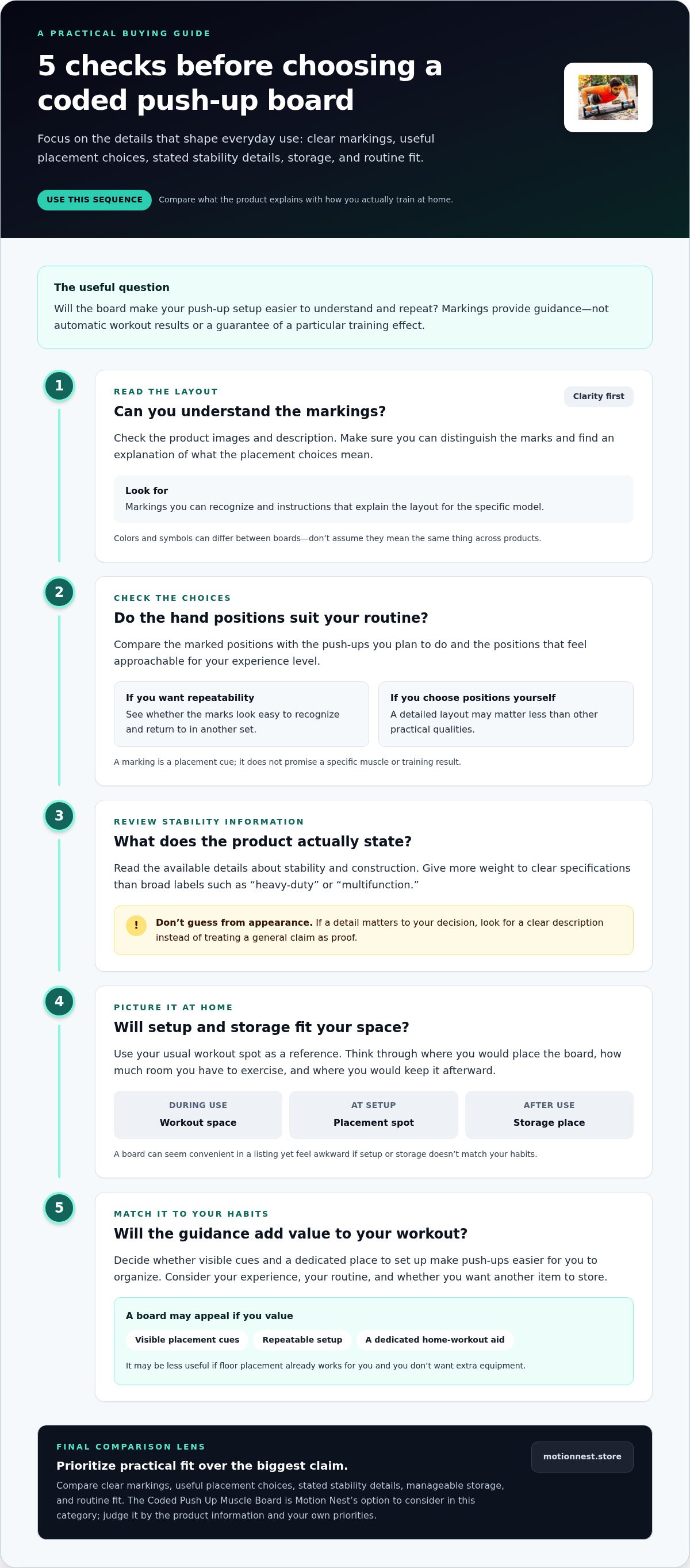
Look closely at the product images and description. Can you distinguish the markings? Does the product information explain what the placement choices mean? Consider whether those positions suit the push-ups you plan to do and feel approachable for your experience level. Don’t assume a marking isolates or guarantees work for a particular muscle. Clear guidance is useful, but it isn’t a promise of a specific result.
Think about how you’ll use the layout in a real session. If you want to repeat the same setup across workouts, check whether the markings look easy to recognize and return to. If you prefer to choose your own hand position, a detailed layout may matter less than other practical qualities.
How to judge practical fit for a home workout
Picture the board in your workout space. Consider where you’ll place it, how much room you have to exercise, and where you’ll store it afterward. A product can look convenient in a listing but still be awkward at home if setup or storage doesn’t fit your habits. Use your usual workout spot as a reference when comparing options.
Review the product information for stated details about stability and construction. Use the information provided rather than treating broad labels such as “heavy-duty” or “multifunction” as proof of quality. If a specification matters to your decision, look for a clear description instead of guessing from appearance.
- Layout legibility: Check whether you can distinguish the markings in the images and understand their intended use.
- Hand-placement options: Compare the choices with the positions you expect to use in your routine.
- Stability information: Review any stated details that help you understand how the board is designed to sit during use.
- Storage and setup: Consider the space needed to exercise and put the equipment away.
- Routine fit: Decide whether the board’s guidance adds value to the way you already work out.
Separate must-haves from nice-to-haves. Read the product details with your routine and space in mind, and don’t focus only on the biggest claim. Compare the Coded Push Up Muscle Board with your priorities before deciding.
Coded Push-Up Board vs. Floor Push-Ups and Push-Up Handles
Choosing between floor push-ups, separate handles, and a coded board comes down to the setup you prefer. A board isn’t required for push-ups. The floor offers a straightforward option, while equipment can provide a different setup or visible placement cues. Compare the formats by how they fit your routine, space, and comfort.
| Option | Placement guidance | Equipment, portability, and storage | May suit you if |
|---|---|---|---|
| Floor push-ups | No marked guidance; choose your own hand position. | No dedicated equipment or storage space needed. | You prefer a simple setup and flexibility. |
| Separate handles | They provide hand supports, but don’t use a coded layout. | They’re additional pieces of equipment to carry and store. | You want handles rather than a marked surface. |
| Coded board | Markings show placement choices on the board. | Requires room to set up and a place to store the board. | You value visible cues for setting up your push-ups. |
When floor push-ups may be the simpler choice
With floor push-ups, you can start without setting out or storing a dedicated board or handles. You also choose your hand placement directly instead of following markings. That simplicity can work well if you’re comfortable with your setup or want to keep your routine equipment-free. A minimal setup doesn’t make the workout less worthwhile. Consistency and a suitable routine matter more than owning extra gear.
When a board or separate handles may suit a routine
A coded board may appeal if visible placement cues help you organize your setup or repeat positions. Separate handles offer another format for people who prefer using handles, without the board’s marked layout. Neither option is automatically better. Think about the equipment you’ll enjoy using, how much room you have to exercise, and whether storing it between sessions feels practical.
For example, someone with a regular workout spot who likes clear visual cues may find a board fits naturally into their routine. Someone who moves between exercise spaces or wants fewer items to put away may prefer floor push-ups. Handles may suit someone who wants that specific equipment format. These are preferences, not rules.
If you plan to buy coded push up board equipment, weigh the guidance against the space and storage it requires. Use the table to identify which setup feels easiest to return to in your everyday routine.
A Simple Checklist for Buying a Coded Push-Up Board
A sensible purchase starts with your routine, not a long list of impressive-sounding claims. Use this checklist to decide what you need, review the product information, and choose an option that suits your home. Set your own budget before browsing, then compare products using stated details rather than assuming accessories or features are included.
Match the board to your routine and space
First, decide what role a board would play in your regular workouts. Would you use its markings to guide your setup, or are you mainly curious about trying something new? Consider the space you need to exercise and where you’d keep the board afterward. Choose for likely ongoing use, not novelty alone. Knowing your routine makes it easier to distinguish a useful purchase from an impulse.
Review the listing before completing the order
Read the product description carefully. Check the exact product name and review the specifications stated on its product page. Don’t assume accessories are included just because they appear in promotional imagery or are mentioned as possibilities. Review the shipping information and money-back guarantee terms before ordering so you understand the purchase details.
To assess whether a layout suits your preferences, focus on the placement choices explained in the product information and how you expect to use them.
Use these steps in order to keep the decision manageable:
- Set your intended use. Write down how a board would fit into your usual workouts and what you want its guidance to add.
- Consider your space. Think through the room you have for exercise and a practical place to store the equipment between sessions.
- Choose your priorities. Decide which details matter most, such as readable placement markings or stated stability information. Keep optional conveniences separate from must-haves.
- Set a private budget. Choose an amount that feels comfortable for your purchase, then use it to narrow your options without letting promotional claims set your expectations.
- Review the product page. Confirm the product name and read the specifications, shipping information, and guarantee terms before you place an order.
- Make the fit decision. Ask whether the stated details match your needs and whether you can see yourself using the board as part of your routine.
This approach keeps the choice grounded in practical fit. If you plan to buy coded push up board equipment, compare the product information with your checklist rather than expecting a board to supply motivation or results on its own.
Motion Nest sells the Coded Push Up Muscle Board. Review its product details and purchase information, then shop the Coded Push Up Muscle Board if it matches your priorities.
Is Motion Nest's Coded Push Up Muscle Board the Right Fit?
Motion Nest sells the Coded Push Up Muscle Board for shoppers considering a coded push-up board for home exercise. Whether it suits you depends on the guidance you want, your routine, and the space you have. The product name identifies the category, but your decision should rest on the information stated on its product page, not assumptions about particular markings, accessories, or results.
If you want visible placement guidance, use the product description to understand what the board offers and compare those details with your priorities. If you’re comfortable doing push-ups without equipment, a board may not add enough value to your routine. Neither choice is automatically right for everyone. Focus on fit, not the idea that equipment alone will build strength or improve fitness.
Who may find this product relevant?
The Coded Push Up Muscle Board may be relevant if you’re looking for coded equipment for home workouts and prefer a product designed around a coded layout. Consider whether that kind of guidance is something you’d use consistently, along with the space you have to exercise and store the board. Read the stated product information to see whether it matches what you want from your routine.
What to expect when shopping with Motion Nest
Motion Nest offers worldwide shipping and advertises fast, reliable shipping. The store also advertises a money-back guarantee. These are store-level assurances, not product specifications. Review the guarantee terms and purchase details before ordering so your decision reflects the information presented.
As you review the listing, compare its stated details with your own checklist:
- Routine: Does this type of equipment suit how you plan to exercise at home?
- Guidance: Are you specifically looking for a coded board, rather than a simple floor-based setup?
- Space: Can you comfortably use and store the equipment where you work out?
- Purchase details: Have you reviewed the product description, shipping information, and money-back guarantee terms?
Those answers can help you make a confident decision without relying on broad workout claims. If you’re ready to buy coded push up board equipment, use the product page to judge whether the Coded Push Up Muscle Board fits your needs. Review the product and decide whether it suits your routine.
Make Your Next Workout Choice with Confidence
The right equipment is the kind you can see yourself using as part of your regular routine. Before you decide, picture where a push-up board would fit into your home workouts and whether its guidance is something you’ll value over time. A thoughtful choice doesn’t need to be complicated. It just needs to make sense for you.
If you’re ready to buy coded push up board equipment, take one last look at the product details and decide whether the Coded Push Up Muscle Board matches your needs. Motion Nest advertises fast, reliable shipping, worldwide shipping, and a money-back guarantee. Review the purchase information, then explore the product at your own pace.
Explore the Coded Push Up Muscle Board and choose the next step that feels right for your home workout routine.
Frequently Asked Questions
Are coded push-up boards good for beginners?
They can be useful for beginners who find visual hand-placement cues helpful, but a board doesn’t teach every part of push-up form. Start with a version of the movement you can do with control, and focus on a comfortable setup rather than trying every marked position at once. If a position causes pain or feels unstable, stop and reassess before continuing. Your pace matters more than the equipment.
Can a push-up board replace a bench press?
No, a push-up board isn’t a direct replacement for a bench press. Push-ups use your body as resistance, while a bench press uses external weight. The equipment and loading are different, so one won’t necessarily meet the same training goal as the other. A board can be part of a home push-up routine, but choose exercises based on the movements and resistance you want in your overall plan.
Can you use a push-up board on carpet?
It depends on the board and the carpet. A thick or soft pile may let equipment shift or rock, so check the board’s product instructions and test its position before putting your weight on it. Set it on a level surface, press down gently to check for movement, and stop if it feels unstable. Don’t assume every board performs the same way on carpet.
How much space do you need to use a coded push-up board?
You need enough clear floor space for the board and for your body to move through the exercise without hitting furniture or walls. Before you buy coded push up board equipment, measure the spot you plan to use and compare it with the product dimensions stated on its page. Also consider whether you can comfortably get into position and move away from the board afterward.
Can more than one person use the same push-up board?
More than one person may use a shared board if its stated product limits suit each user and everyone can position themselves comfortably. Review the product information rather than assuming the board has a particular weight capacity or fits every body. For shared use, agree on where it’s stored and wipe away sweat between users, following any care directions provided with the product.
How should you clean a push-up board?
Follow the product’s care instructions first, since cleaning methods can depend on its materials. For general upkeep, remove loose dust and wipe sweat away with a soft cloth. Avoid soaking the board or using harsh cleaners unless the care guidance says they’re suitable. Let it dry fully before storing it, and keep it in a clean, dry spot between workouts.